 Specs

Roborock Q7 Max
The LiDAR vacuum-and-mop robot with the biggest onboard bin in this cluster and no washing dock to maintain
Scored on the published rubric, from documentation, pricing and verified user reports.
Best for: Homes that want LiDAR mapping, a 470 ml bin and a simple charging dock, and do not want to fill, empty or wash a station every week.
Verdict
The Roborock Q7 Max is the plain sheet in our mid-range robot vacuum cluster. Roborock publishes 4200 Pa suction in Max+ mode, a 5200 mAh battery rated for up to 3 hours, a 470 ml dustbin and a 350 ml water tank, the largest onboard bin of the four robots we lined up. This is a documentation review built from the us.roborock.com product page and the Roborock service and warranty page, both checked October 10, 2026; we did not run the unit. The strong rows are the bin, the mapping list and the price when the $159.99 sale is live. The weak rows are everything a dock would do: there is no auto-empty, no mop washing and no drying, and the mop is a 300 g pad with a 30-level pump rather than rotating pads. Roborock does not publish a noise figure, a climbing height or a charging time, and the warranty is one year, the shortest in the cluster alongside eufy and ECOVACS. On October 10, 2026 the page showed the robot out of stock at the sale price, which turns the best value row here into a waiting game.
Visit Roborock Q7 Max
We have no affiliate relationship with this vendor. Link goes to the official site.
Where it is strong
- 470 ml onboard dustbin, the largest of the four robots in this cluster
- 5200 mAh battery with a published runtime of up to 3 hours
- PreciSense LiDAR, 3D mapping, up to four stored floor plans, no-go zones and invisible walls
- 30 water flow levels and 300 g mop pressure printed on the sheet
- Published maximum areas: 3229 sq ft vacuuming, 2583 sq ft mopping
- Sale price of $159.99 when in stock, the lowest list-or-sale figure in the cluster
Where it falls short
- No auto-empty, no mop washing, no drying: the charging dock only charges
- Noise, climbing height, charging time and per-mode runtime are not published
- One-year limited warranty; extensions cost $34 or $52
- Mop is a single flat pad, not rotating pads with downward pressure
- Listed out of stock at the $159.99 sale price on October 10, 2026
- 2.4 GHz Wi-Fi only
What the Roborock Q7 Max actually is
The Q7 Max is a round LiDAR robot that vacuums and mops in one pass, ships with a charging dock and nothing else, and sits one step below Roborock's Q8 and Qrevo lines. The sheet describes a combined 470 ml dustbin and 350 ml water tank, a flat mop pad on a mount and an electronic pump.
The current us.roborock.com page sells it in white and black at $599.99 list and $159.99 sale. Both variants carried an out of stock, coming soon label when we read the page on October 10, 2026.
This is a documentation review. Every figure here comes from the product page and Roborock's service and warranty page. We did not operate the unit and we do not fill gaps with retailer listings.
The short version: this sheet wins the onboard bin row and the sale price row, and leaves every dock row empty that the Dreame L40 Ultra Gen 2 and ECOVACS DEEBOT N30 Pro Omni fill in.
Who the Roborock Q7 Max is best for
The sheet points at a buyer who wants mapping and capacity, not automation.
- An apartment or single-floor home on sealed hard floors with some low-pile rugs
- A household that would rather empty a 470 ml bin every few runs than clean a station's water tanks
- A buyer who wants LiDAR mapping, room-by-room scheduling and no-go zones at the lowest price in this cluster
- Someone who already owns the Auto-Empty Dock Pure or plans to add it later
- A buyer with 2.4 GHz Wi-Fi who does not need the robot on a 5 GHz network
- Who should skip it: anyone who wants mop pads washed and dried automatically
- Who should skip it: anyone who needs a published noise figure before buying for a bedroom
The numbers Roborock publishes, and the ones it does not
Roborock prints 4200 Pa suction with the test condition stated as Max+ mode on a full battery. It prints a 5200 mAh battery and a runtime of up to 3 hours. The combined bin and tank unit is 470 ml for dust and 350 ml for water.
The mop row is unusually complete for a flat-pad robot: 30 water flow levels and 300 g of mop pressure. Navigation is PreciSense LiDAR with 3D mapping support, and the app stores up to four floor plans with no-go zones, invisible walls, custom routines, scheduling, voice control and a child lock.
Dimensions are 13.90 by 13.78 by 3.80 inches and weight is 8.38 lb. Maximum areas are 3229 square feet vacuuming and 2583 square feet mopping. Wi-Fi is 2.4 GHz only.
Not published on the US product page as of October 10, 2026: noise in dB, climbing or threshold height, charging time, runtime per suction mode, a customer rating or review count, and any obstacle camera. The sensor list names cliff sensors, accelerometers and bumpers only.
How the price and warranty are structured
The list price is $599.99 and the sale price is $159.99. That is a 73 percent gap, an editorial calculation, and the largest list-to-sale spread of the four sheets in this cluster.
The catch is stock. Both colours showed out of stock, coming soon on October 10, 2026. A sale price on a robot you cannot add to the cart is a reference figure, not a purchase price, and we score value with that in mind.
The standard warranty is one year. Roborock sells an extension at checkout: one extra year for $34 or two extra years for $52. Buying the two-year extension at the sale price gives three years of cover for about $212, an editorial sum.
Roborock's returns page allows a return or replacement for any reason within 30 days of delivery. Consumables such as brushes and filters sit outside the warranty. For how this compares with Dreame's three-year main-body term, read the mid-range robot vacuum shortlist.
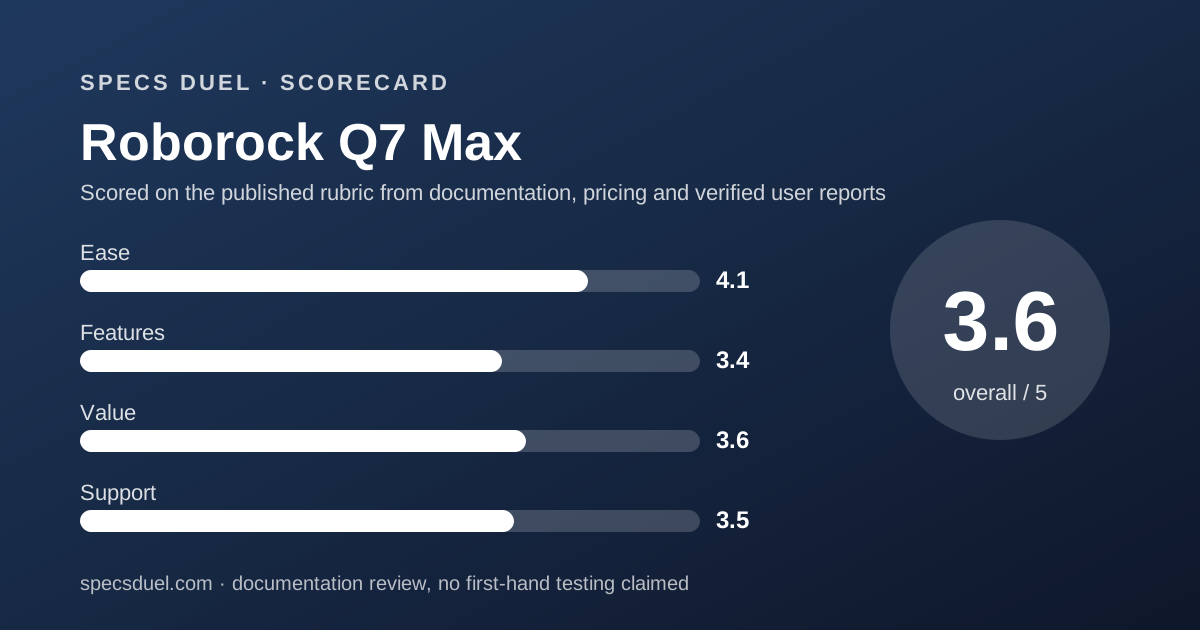
Ease of use: what the 4.1 is built from
Ease rewards setup and maintenance that need no manual. LiDAR robots map a home on the first run, and the Q7 Max sheet lists 3D mapping, four stored maps and quick room editing in the app.
Maintenance is the simplest in the cluster because there is no station to drain or refill. The trade is that the 470 ml bin and 350 ml tank are emptied and filled by hand, and the mop pad is washed by hand after every mop run.
The 30 water levels and 300 g pressure are set in the app per room, which is more adjustment than most flat-pad robots print.
The deductions are the 2.4 GHz only Wi-Fi, which trips up some mesh networks, and the absence of a camera, which means socks and cables are handled by bumpers rather than avoidance. Roborock does not print a dB figure, so night running is a guess.
Features: what the 3.4 is built from
Features are scored on documented hardware, not names. The Q7 Max documents LiDAR, 3D mapping, four maps, no-go zones and invisible walls, scheduling, routines, voice control, child lock, a 30-level pump and a pressurised flat mop.
Against the cluster, the missing rows are the dock rows. The Dreame L40 Ultra Gen 2 documents auto-empty into a 3.2 L bag, hot-water mop washing, hot-air drying and auto refill of the robot's tank. The eufy X10 Pro Omni documents rotating pads with 1 kg of downward pressure and a 12 mm lift.
The Q7 Max has none of that. It cannot lift its mop, so carpet is either excluded from mop runs or dampened. It has no camera, so there is no object recognition.
A 3.4 means the mapping and app list is complete and the cleaning hardware list is from an earlier generation. For a buyer who sees a dock as one more thing to clean, add a few tenths back.
Value: what the 3.6 is built from
Value is price against published capability, with stock taken into account. At $159.99 the Q7 Max would be the clear value row of the cluster: less than a third of the Dreame's $569.99 and about half of the $315.00 the ECOVACS page displayed on the same date.
At $599.99 list the picture flips. The Dreame L40 Ultra Gen 2 is $30 cheaper at its sale price and documents a full station, 25,000 Pa and a three-year warranty.
Because the sale price was not purchasable on October 10, 2026, we score value between the two: 3.6. If the robot returns to stock at $159.99, the editorial view is that the score would move above 4.
Running cost is low on paper. There are no dock bags to buy, and the only consumables are the filter, brushes and mop cloth. Roborock sells mop cloths in four-packs and washable filters in pairs; prices are on the accessories pages rather than the product page.
Support: what the 3.5 is built from
Support is scored on warranty length, conditions and documentation completeness. Roborock's service and warranty page states that new products are reasonably free from defects in materials and workmanship for one year from the purchase date, and certified refurbished units for six months.
Exclusions include consumable components such as brushes, non-Roborock products bundled with the robot, and accessories or cleaning solutions not approved by Roborock. Batteries are not named either way.
One year is the shortest term in this cluster, tied with eufy and ECOVACS and two years behind Dreame's three-year main-body term. The paid extension is the only route to longer cover.
Documentation is thinner than Dreame's: no noise, no climbing height, no charging time, no per-mode runtime. The product page does show an owner review anchor but no rating or count. That combination lands support at 3.5.
What verified users report
The us.roborock.com product page displayed no customer rating or review count when we read it on October 10, 2026, so there is no official owner score to quote for this model.
We do not import retailer star ratings into the spec table. Where owner reports on retailer pages agree, the recurring themes for flat-pad Roborock Q models are that mapping is quick and accurate, the mop pad dampens rather than scrubs, and the robot pushes cables and socks around because it has no camera. Those are user observations, not specs.
The one spec-adjacent complaint that appears repeatedly is Wi-Fi: owners on mesh systems that merge 2.4 and 5 GHz bands report setup trouble. The sheet confirms 2.4 GHz only, so that report matches the documentation.
None of this changes the table; it sits beside it. If a Roborock-hosted rating appears, we will add it in the changelog.
Limits stated by the vendor
Roborock states the 4200 Pa figure applies in Max+ mode on a full battery. Pa figures are produced by each maker's own method and are not a cross-brand yardstick; the Dreame sheet's 25,000 Pa and the ECOVACS sheet's 10,000 Pa come from different test setups.
The runtime is up to 3 hours, which in robot vacuum sheets means the lowest suction setting on hard floor. Expect less in Max+ mode; Roborock does not print how much less.
Wi-Fi is 2.4 GHz only and 5 GHz is not supported. The robot is compatible with the Auto-Empty Dock Pure, which is sold separately and whose bag capacity is listed on that dock's page, not this one.
Both colours were out of stock on October 10, 2026. Buyers should check availability before planning around the $159.99 figure.
Alternatives on this site
Dreame L40 Ultra Gen 2. Choose it if you want the robot to empty, wash, dry and refill itself and a three-year warranty: $569.99 on October 10, 2026, with 25,000 Pa, a 3.2 L bag and 4.5 L and 4.0 L tanks. Otherwise choose the Q7 Max if a station is unwanted and the sale price is live. Rows in the Dreame L40 Ultra Gen 2 spec sheet.
ECOVACS DEEBOT N30 Pro Omni. Choose it if you want a washing and drying dock at the lowest displayed price in the cluster, $315.00 on the ECOVACS US store on October 10, 2026, with a published 65.3 dBA noise row. Otherwise choose the Q7 Max for the bigger onboard bin. Rows in the DEEBOT N30 Pro Omni spec sheet.
eufy X10 Pro Omni. Choose it if rotating pads with 1 kg of pressure matter and $899.99 is in budget. Otherwise the Q7 Max is the cheaper mapping robot by a wide margin. Rows in the eufy X10 Pro Omni spec sheet and the eufy vs Dreame duel.
To see all four ranked by what the makers publish, read the mid-range robot vacuum shortlist or browse the Robot Vacuums topic page.
Bottom line
The Roborock Q7 Max publishes 4200 Pa, a 5200 mAh battery rated up to 3 hours, a 470 ml bin, a 350 ml tank, 30 water levels, 300 g mop pressure, LiDAR with four maps and a one-year warranty, all per us.roborock.com pages checked October 10, 2026.
It publishes nothing about noise, climbing height or charging time, and it has no dock functions at all.
On our rubric it scores 3.7 overall, the lowest of the four sheets in this cluster, mainly because the dock rows are empty and the warranty is one year. At the $159.99 sale price in stock it is the cheapest LiDAR robot here by a wide margin. At $599.99 list, the Dreame sheet wins every duel.
Visit Roborock Q7 Max
We have no affiliate relationship with this vendor. Link goes to the official site.