 Specs
SpecsCoway AP-1512HH vs Blueair 311i Max: airflow per watt
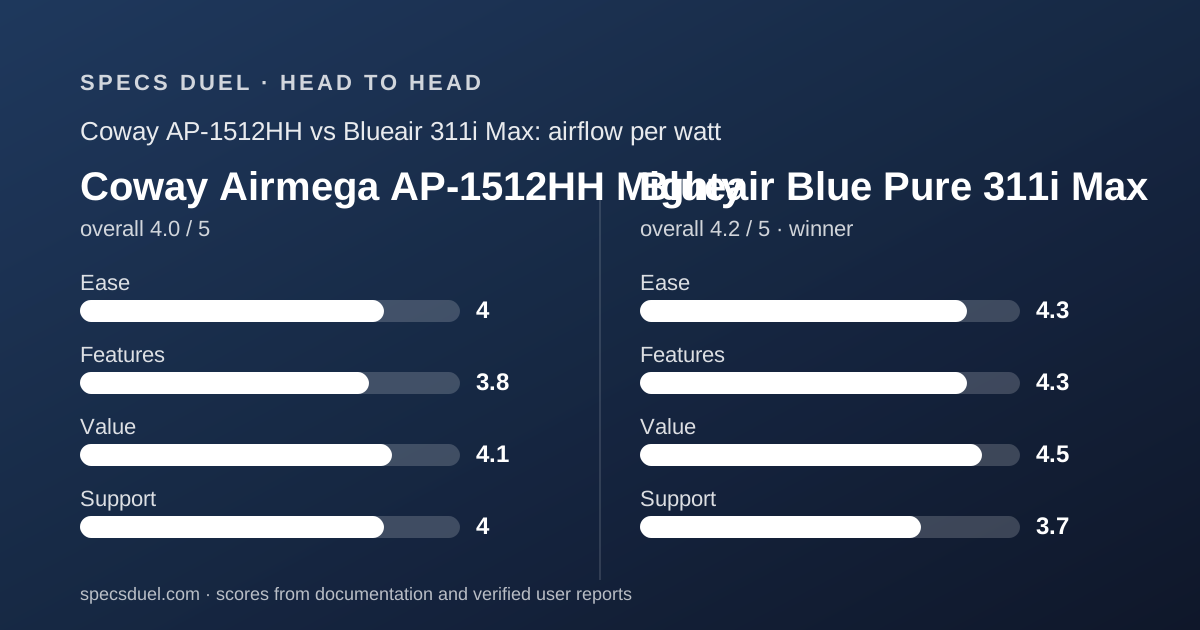
The short answer. The Blueair Blue Pure 311i Max is best for rooms of 300 to 440 square feet, low power draw, a quiet floor and app control. The Coway Airmega AP-1512HH Mighty is best for buyers who want a three-year motor warranty without registration, a printed filter schedule and no Wi-Fi. Winner on the full sheet: the Blueair, which publishes 50 to 125 CFM more on every pollutant row, covers 78 more square feet at 4.8 air changes an hour, draws 45 W less and costs $10 less. The Coway wins the warranty row and the deodorisation filter row. This duel is a documentation review built from cowaymega.com and blueair.com pages checked October 10, 2026. No lab tests, no sponsored rows.
 4.0Coway Airmega AP-1512HH Mighty
 4.2Blueair Blue Pure 311i Max
Row by row: the Blueair wins airflow, power, price and weight; the Coway wins warranty
Every row below is Coway first, Blueair second, then the difference. Figures are from the cowaymega.com product page, filter set page and warranty table, and from the blueair.com US product page and warranty page, all checked October 10, 2026. Where a maker does not print a figure, the row says not published.
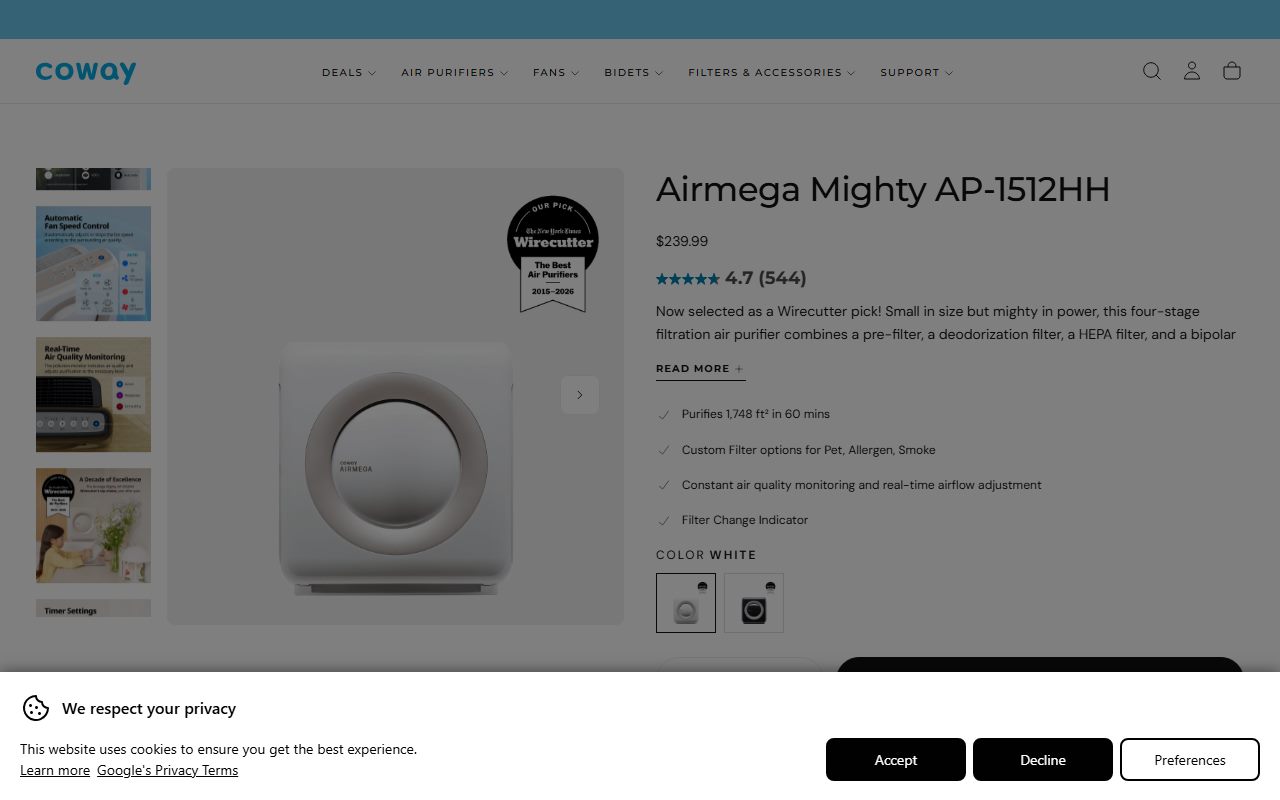
- Regular price: $239.99 | $229.99 | Blueair $10 cheaper
- CADR smoke: 233 | 283 cfm | Blueair +50
- CADR dust: 246 | 314 cfm | Blueair +68
- CADR pollen: 240 | 365 cfm | Blueair +125
- Room at 4.8 ACH: 361 sq ft | 439 sq ft | Blueair +78 sq ft
- Room at 1 ACH: 1,748 sq ft | not published | no comparison possible
- Noise floor: 24 dB(A) | 23 dB | Blueair 1 dB quieter
- Noise ceiling: 53 dB(A) | 50 dB | Blueair 3 dB quieter
- Rated power: 77 W | 32 W | Blueair uses 45 W less
- Weight: 12.3 lb | 7.8 lb | Blueair 4.5 lb lighter
- Footprint: 16.8 x 9.6 in | 12.5 x 12.5 in | Blueair about 5 square inches smaller, and square
- Height: 18.3 in | 19 in | Blueair 0.7 in taller
- Filter price: $59.79 per set | $44.99 list, $33.75 subscription | different intervals, see pricing section
- Filter interval: 6 months / 1 year, printed | up to 9 months | Coway fixed, Blueair variable
- Filter options: one stack | three cartridges | Blueair more choice
- Warranty: 3 years motor, no condition stated | 1 year, extended by registration | Coway clearer
- App and voice: none | app, Alexa, geofencing | Blueair only
- Modes: Auto, Eco, 1 to 3 | Auto, Night, 1 to 3 | Coway has Eco, Blueair has Night
- Timer: 1, 4 or 8 hours | app timer and schedules | Blueair more flexible
- Owner rating on maker page: not published | 4.6 from 2,226 | Blueair only
- Stock on October 10, 2026: both colours sold out | in stock | Blueair available
Airflow: the Blueair publishes more on every pollutant and covers 78 more square feet
Both makers print three CADR figures, which makes this the cleanest airflow duel in the cluster. Coway lists 233 smoke, 246 dust and 240 pollen. Blueair lists 283 smoke, 314 dust and 365 pollen cfm.
The Blueair leads by 50 on smoke, 68 on dust and 125 on pollen. The pollen gap is the largest, which matters to the allergy buyer this size of purifier usually serves.
Room size at 4.8 air changes an hour is 361 square feet for the Coway and 439 for the Blueair, a 78 square foot gap. Coway also prints 874 square feet at 2 ACH and 1,748 at 1 ACH; Blueair prints only the 4.8 ACH figure.
One caveat sits on the Blueair side. Its page states the CADR and room figures were updated to meet new DOE standards and that packaging may differ. Older third-party reviews quote 250 cfm across the board. The current sheet is what we duel.
Conclusion: the Blueair wins airflow on every published row. Details in the Coway AP-1512HH spec sheet and the Blueair 311i Max spec sheet.
Power: the Blueair moves more air on 32 W than the Coway does on 77 W
This is the widest row in the duel. The Coway's rated power is 77 W. The Blueair's is 32 W. The Blueair moves 21 percent more smoke CFM on 42 percent of the electricity.
Airflow per watt, an editorial calculation, is 3.0 CFM per watt for the Coway on the smoke figure and 8.8 CFM per watt for the Blueair. Blueair attributes the difference to HEPASilent, which charges particles so a looser filter and slower fan can capture them.
Around the clock, the Coway would use about 675 kWh a year and the Blueair about 280 kWh. At a 16 cent US average rate that is roughly $108 against $45, or about $63 a year in the Blueair's favour. Over three years that is more than the $10 price difference many times over.
Neither maker prints power at each speed, so both figures are maximum draw. Eco mode on the Coway and Night mode on the Blueair will pull less in practice, but neither sheet quantifies it.
Conclusion: the Blueair wins power decisively. For a unit that runs all day, this row alone can decide the duel.
Noise: the sheets are one decibel apart on low and three on high
The Coway's sheet says 24 to 53 dB(A). The Blueair's says 23 dB on low and no louder than 50 dB on high.
One decibel on the floor is not something a person notices. Three decibels on the ceiling is a noticeable step and it comes at the speed a buyer uses when the air is bad.
The modes differ in a way the dB rows do not show. The Blueair has a Night mode that dims the display and drops the fan. The Coway has Eco, which turns the fan off after 30 minutes of clean readings, but no named night or display-off mode. Owner reviews of the Coway repeatedly mention a bright indicator light in bedrooms.
Neither maker prints dB at each of the three numbered speeds.
Conclusion: the Blueair wins noise by a small margin on paper and by a larger margin on bedroom practicality, because of Night mode.
Pricing and filters: $10 apart to buy, and the filter rows depend on how you read 'up to 9 months'
The Coway is $239.99 and the Blueair is $229.99, both regular prices with no sale shown on October 10, 2026. Both Coway colours were listed sold out; the Blueair was in stock.
Cost per CFM: the Coway is $1.03 per smoke CFM, the Blueair $0.81. On pollen the gap is wider, $1.00 against $0.63. The Blueair buys more airflow per dollar on every row.
Filters need care. Coway sells a $59.79 set with one HEPA rated one year and two deodorisation filters rated six months. One set is one year, so $59.79 a year with no assumption.
Blueair sells a $44.99 Particle & Carbon filter, $33.75 on subscription, rated up to 9 months. At 9 months that is 1.33 filters a year, about $59.99 at list or $45.00 on subscription, an editorial calculation. At 6 months, the shortest subscription interval, it is $89.98 at list. Blueair's RealTrack feature sets the real interval from fan use.
Blueair also lists AllergenBlock at $64.99 and SmokeBlock at $59.99 for buyers with a specific problem. Coway has one stack.
Conclusion: the Blueair wins purchase price and cost per CFM. Filter cost is a tie at list and a Blueair win on subscription. The Coway wins filter documentation, because its interval is fixed and printed.
Controls and app: the Blueair is a connected device, the Coway is deliberately not
The Blueair 311i Max lists Wi-Fi, the Blueair app with timer and schedules, Alexa voice control, Auto and Night modes, a display lock, RealTrack filter tracking and Welcome Home geofencing. On the unit itself there is one touch button.
The Coway AP-1512HH lists a physical button panel with Auto, speeds 1 to 3, Eco, a 1, 4 or 8 hour timer, an air quality indicator and a filter change indicator. No Wi-Fi, no app, no voice.
The Coway's offline design is a feature for some buyers: no pairing, no firmware, no account. The one-star group in Blueair's own reviews is where app pairing complaints live.
The Blueair's design is a feature for others: schedules from a phone, a filter countdown that adjusts to use, and a night mode that darkens the room.
Conclusion: the Blueair wins on documented controls. The Coway wins for the buyer who has decided against connected appliances. For a third option with an app at $149.99, see the Levoit Core 300S spec sheet.
Size and placement: the Blueair is lighter and square, the Coway is wide and flat
The Coway is 16.8 inches wide, 9.6 inches deep and 18.3 inches tall at 12.3 lb. The Blueair is 12.5 inches square and 19 inches tall at 7.8 lb. Blueair prints its dimensions without units; we read them as inches, which matches the weight and the product photos.
Footprints are close: about 161 square inches for the Coway and 156 for the Blueair. The shape differs. The Coway's front intake needs clearance on one side; the Blueair's 360-degree intake can sit in a corner or mid-room.
The 4.5 lb weight gap matters if the unit travels between rooms. The Blueair is a one-hand carry for most adults; the Coway is a two-hand lift.
Conclusion: the Blueair wins placement on weight and intake design. On raw floor area the two are a draw.
Warranty and support: the Coway's three years on the motor needs no registration
Coway's warranty table gives one year on any internal or functional part and three years on motor and electronic parts for the AP-1512HH, from the retail purchase date. Registration links exist, but the table does not say registration is required to claim. Filters and damage from non-genuine filters are excluded.
Blueair's standard limited warranty on Blue Pure models is one year. Registration within 60 days of purchase extends it. The two Blueair pages we read disagree on the extension: the product page says three years, the warranty terms page says two. We treat two as the floor until Blueair reconciles them.
So the Coway offers a longer unconditional term on the part that fails expensively. The Blueair matches or beats it only if the buyer registers on time, and even then the number is unclear.
On documentation the Blueair sheet is slightly more complete: it has an owner rating and filter prices on the product page, and flags its own CADR revision. Coway keeps its warranty and filter price on separate pages.
Conclusion: the Coway wins warranty. The Blueair wins transparency on the product page.
What users report: only Blueair publishes a score, and it is 4.6 from 2,226 reviews
The blueair.com US product page shows 4.6 out of 5 from 2,226 reviews, with 88 percent recommending, as of October 10, 2026. The split is about 1,800 five-star and 134 one-star. Five-star reviews cite quiet running and the app; one-star reviews cluster around app connection and units that stopped responding.
The cowaymega.com product page shows no rating or review count. A retailer sample at Sylvane shows 4.8 from 95 reviews with 97 percent recommending. The recurring complaint is the bright indicator light at night; noise at speed 3 and a plastic smell when new appear less often.
The two samples are not comparable in size. A 95-review retailer sample cannot be ranked against a 2,226-review maker sample.
Conclusion: the Blueair wins on the existence of an official owner score. On the content of complaints, the Coway's are about a light and the Blueair's are about Wi-Fi, which is consistent with what each sheet contains.
Choose the Coway AP-1512HH if, choose the Blueair 311i Max if
The sheets split by warranty philosophy and by whether the buyer wants a connected device.
- Choose the Coway if a three-year motor warranty with no registration step is the deciding row
- Choose the Coway if you want the filter schedule printed: six months and one year, not up to nine
- Choose the Coway if you do not want Wi-Fi in the purifier at all
- Choose the Coway if a separate deodorisation filter as standard matters for cooking or pets
- Choose the Blueair if the room is 360 to 440 square feet, where the Coway's sheet runs out
- Choose the Blueair if the unit runs all day, because 32 W against 77 W is about $63 a year at US rates
- Choose the Blueair if you want app schedules, Night mode and filter tracking
- Choose the Blueair if pollen is the problem, because 365 against 240 cfm is the widest row in the duel
Frequently asked
Is the Blueair 311i Max better than the Coway AP-1512HH? On the published sheets, yes, on airflow, power, price, weight and controls. The Coway is better on warranty terms and filter documentation. Which matters more is the buyer's call, and the rows above lay it out.
Which is cheaper over three years? The Blueair, by an editorial estimate. It is $10 less to buy, about $63 a year less to run at a 16 cent US rate, and roughly equal on filters at list. That is about $200 over three years before any subscription discount.
Which is better for a bedroom? The Blueair on the sheet: 1 dB quieter on low, 3 dB quieter on high, and a Night mode that dims the display. Coway owners often report covering the indicator light.
Do both publish CADR for smoke, dust and pollen? Yes, which is why this duel is cleaner than the one against the Levoit Core 300S, which prints a single figure. See the Levoit vs Coway duel.
Which should a 250 square foot room pick? Either covers it with margin. The room-size shortlist places the Coway at 250 to 360 and the Blueair above that, with the power row as the tiebreak.
Bottom line
On the full sheet the Blueair Blue Pure 311i Max wins this duel. It publishes 283 to 365 cfm against the Coway's 233 to 246, covers 439 square feet at 4.8 ACH against 361, draws 32 W against 77, weighs 7.8 lb against 12.3, costs $10 less and carries the only official owner score, 4.6 from 2,226 reviews.
The Coway Airmega AP-1512HH Mighty wins two rows that some buyers rank first: a three-year motor warranty with no registration condition, and a filter schedule printed in months rather than up to months. It is also the pick for anyone who wants no Wi-Fi in the appliance.
If you buy the Blueair, register it within 60 days. If you buy the Coway, check stock first, because both colours were sold out on October 10, 2026.
Both sheets, plus the Levoit, sit on one table in the air purifier shortlist by room size and on the Air Purifiers topic page. All figures per cowaymega.com and blueair.com, checked October 10, 2026. No lab tests.
Visit Coway Airmega AP-1512HH Mighty
We have no affiliate relationship with this vendor. Link goes to the official site.
Visit Blueair Blue Pure 311i Max
We have no affiliate relationship with this vendor. Link goes to the official site.