 Specs

Anker SOLIX C1000
The only sheet in this power station cluster that prints four certification numbers, and the only one that prints no noise figure
Scored on the published rubric, from documentation, pricing and verified user reports.
Best for: A buyer who wants the largest AC inverter and the most outlets per dollar in this cluster, and who will accept a page that prints no noise figure and two different product names for the same unit.
Verdict
The Anker SOLIX C1000 prints the biggest inverter and the most outlets in this cluster, and it is the only one of the three sheets that names a safety standard. Anker publishes 1056Wh of LiFePO4 capacity, 3,000 cycles to 80%+, 1800W pure sine wave continuous with a 2400W surge, six AC outlets, a 120W car port, two 12W USB-A ports, a 100W and a 30W USB-C port, 600W of solar input at 11-60V MPPT, 1300W maximum AC input, a UPS switch time under 20 ms, expansion to 2112Wh, 28.44 lb and a 5-year warranty. Its FAQ names four SGS-audited UL standards: UL 1012, UL 1778, UL 1973 and UL 60730. This is a documentation review built from the ankersolix.com product page rendered in a headless browser on October 24, 2026, plus the structured data embedded in that page. Nobody here plugged anything in. Two rows failed: there is no noise figure we could read, and the page sells the unit under two different names.
Visit Anker SOLIX C1000
We have no affiliate relationship with this vendor. Link goes to the official site.
Where it is strong
- 1800W continuous and 2400W surge, the largest inverter in this cluster, printed as pure sine wave
- Six AC outlets against three on both rival sheets, plus a 120W car port and four USB ports
- The only sheet here that names a standard: UL 1012, UL 1778, UL 1973 and UL 60730, audited by SGS per the page FAQ
- Expansion to 2112Wh with an expansion battery, printed as a specification row rather than marketing copy
- Solar input of 600W at 11-60V MPPT, which is 50 percent more than the Jackery sheet and nearly three times the EcoFlow figure
- Both dimension systems and both weight units printed, and a 5-year warranty row inside the specification table
Where it falls short
- No noise figure we could read; the only dB string on the page belongs to a 300W cross-sell card, not to this unit
- The page sells one unit under two names: the title and structured data say C1000X, the specification table and FAQ say C1000
- The 58-minute 0-100% charge claim sits in the marketing bullet list, not in the specification table, which prints only 1300W maximum input
- Heaviest unit in this cluster at 28.44 lb, and the largest footprint at about 119 square inches
- Only 2 owner reviews on the page, both dated October 2026, one of them from a buyer who had not received the unit
- The 10-year lifespan claim in the bullet list has no stated duty cycle behind it anywhere we could read
At a glance
| Capacity | 1056Wh |
|---|---|
| Battery chemistry | LiFePO4 (Lithium Iron Phosphate) |
| Cycle life | 3,000 cycles to 80%+ capacity |
| AC continuous output | 1800W pure sine wave |
| AC surge output | 2400W (SurgePad) |
| AC outlets | 6 |
| USB and DC outputs | 2x 12W USB-A, 1x 100W USB-C, 1x 30W USB-C, car port 120W at 12V/10A |
| AC input | Max. 1300W; bullet list claims 0-100% in 58 mins, no time row in the specification table |
| Solar input | Max. 600W, 11-60V MPPT |
| UPS switch time | Under 20 ms |
| Expandable to | 2112Wh with an expansion battery |
| Operating range | Discharge -4F to 104F; charge 32F to 104F |
| App and radios | Anker app over WiFi and Bluetooth |
| Dimensions | 14.8 x 8.07 x 10.5 in / 37.6 x 20.5 x 26.7 cm |
| Weight | 28.44 lb / 12.9 kg |
| Noise | No figure we could read on October 24, 2026 |
| Certification | SGS-audited to UL 1012, UL 1778, UL 1973 and UL 60730, per page FAQ |
| Warranty | 5-year warranty; 30-day money-back guarantee stated in the trust strip |
| Price | $469.99 in cart, $599.99 list, read October 24, 2026 |
| Pricing note | $469.99 in the cart on ankersolix.com, list price $599.99, auto-applied code WSTDHALL62 (read October 24, 2026) |
What the Anker SOLIX C1000 actually is
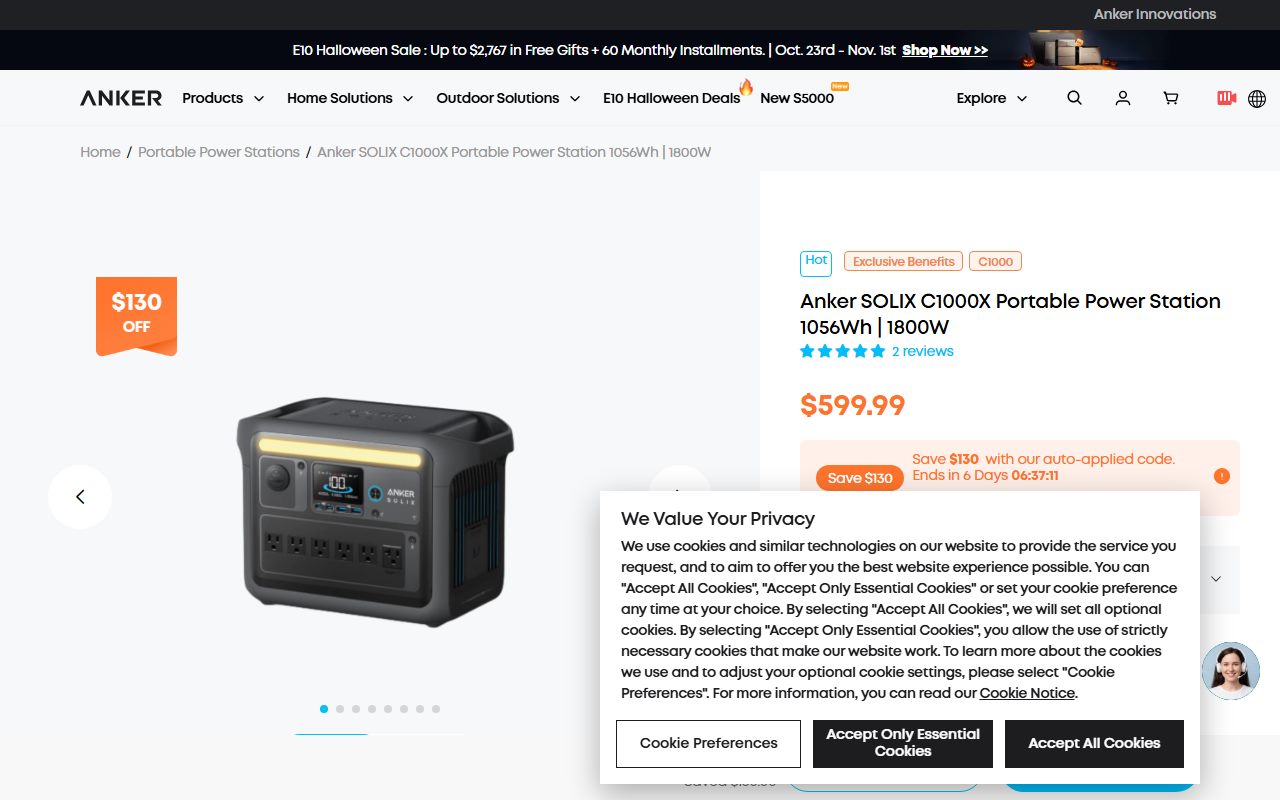
The SOLIX C1000 is a 1056Wh LiFePO4 power station with an 1800W pure sine wave inverter and six AC outlets. Anker lists it at $599.99 and sold it for $469.99 in the cart on the read date.
The inverter is the reason to open this sheet. 1800W continuous with a 2400W surge is the largest pair in this cluster, and six outlets is double what either rival prints.
This page is a documentation review.
Every figure below comes from the ankersolix.com product page for SKU A1761111, rendered in a headless browser on October 24, 2026, plus the product markup embedded in that same page.
Nothing was plugged in and nothing was measured.
One caution before the table. The page carries two product names for one unit, and the row most buyers want next after capacity, the noise figure, is not on it in any form we could read.
Who the Anker SOLIX C1000 is best for
This sheet points at the buyer who sizes a power station by what it can run, not by what it weighs.
- A home office or a kitchen counter where several loads plug in at once, given six AC outlets rather than three
- A circuit that has to carry a kettle or a small heater, at 1800W continuous with a 2400W declared surge
- A desk that needs short-outage cover, with a printed UPS switch time under 20 ms
- A buyer who will add capacity later, since expansion to 2112Wh is a specification row rather than a hint
- A solar setup already built around panels in the 11-60V range, at 600W maximum input with MPPT
- A procurement process that needs a named standard, because UL 1012, UL 1778, UL 1973 and UL 60730 are printed in the page FAQ
- Who should skip it: anyone carrying the unit any distance, at 28.44 lb, the heaviest of the three sheets
- Who should skip it: anyone who needs a published noise figure before the unit goes in a bedroom
The numbers Anker publishes, and the one we could not read
The specification table is the fullest of the three in this cluster. Capacity 1056Wh. Battery type LiFePO4. Battery lifecycle 3,000 cycles to 80%+ capacity. AC continuous output 1800W pure sine wave. AC surge output 2400W.
Outputs: six AC outlets, a cigarette lighter port at 120W and 12V/10A, two 12W USB-A ports, one 100W USB-C and one 30W USB-C.
Inputs: solar recharge to a maximum of 600W at 11-60V with MPPT, and AC recharge to a maximum of 1300W.
The rest of the table: UPS switch time under 20 ms, scalability to a maximum 2112Wh with an expansion battery, discharging temperature -4F to 104F, charging temperature 32F to 104F, WiFi and Bluetooth for the app.
Physically: 14.8 x 8.07 x 10.5 inches, 37.6 x 20.5 x 26.7 cm, net weight 28.44 lb or 12.9 kg. Warranty five years.
One row stayed blank after a headless render of the page and a search of the raw markup: noise.
That is a row we failed to find on October 24, 2026, not a row we can prove Anker has never published.
Where the page argues with itself: one unit, two product names
The page title, the social metadata and the embedded product markup all read Anker SOLIX C1000X Portable Power Station 1056Wh | 1800W, with SKU A1761111.
The specification table heading on the same page reads C1000 Portable Power Station. The selected purchase option reads Anker SOLIX C1000 Portable Power Station. All seven FAQ answers say Anker SOLIX C1000.
So a buyer searching either name lands on the same URL and cannot tell from the page whether C1000 and C1000X are one product or two.
We print both names and treat the mismatch as a defect in the sheet rather than guessing which one is current.
The second awkward spot is cheaper to explain. A feature strip further down the page lists IP67 Outdoor Protection next to 23% Conversion Rate and 3-Angle Adjustment.
Those two neighbours are solar panel properties, so the IP67 rating is not carried into our table as a property of the power station.
The 58-minute charge claim is in the bullet list, not the specification table
Anker's headline charging claim reads HyperFlash AC Input, 0-100% in 58 mins. It sits in the Product Features bullet block above the buy button.
The specification table, eight screens lower, prints AC Input Recharge: Max. 1300W and no time row of any kind.
Those are two different grades of statement. A wattage ceiling is a property of the hardware; a 58-minute figure depends on a starting state of charge, a cell temperature and a mains voltage none of which the page states.
We print the 58-minute claim as a marketing bullet and the 1300W as the specification. Both were read on October 24, 2026.
The contrast with the EcoFlow sheet is worth noting. There the charging figure sits inside the specification row itself, as 380W 0-100% in 60 min, which ties the time to a stated input power.
The same discipline applies to our air fryer sheets, where the Ninja Air Fryer Pro XL prints 14.6 amps as a row while its fat-reduction claim stays in the copy.
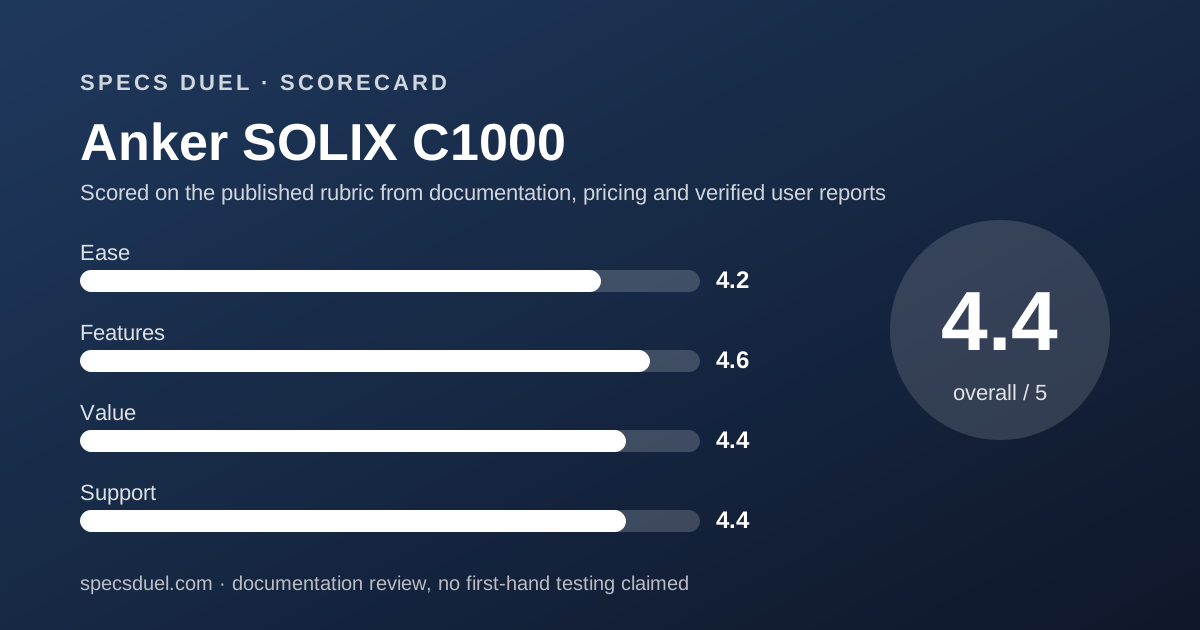
Ease of use: what the 4.2 is built from
Ease rewards a sheet that tells a buyer what plugs in, where, and how the unit is controlled.
The output block here is the most complete of the three. Six AC outlets is double either rival. The car port is rated in both watts and amps, at 120W and 12V/10A, which is more than the Jackery sheet gives for the same port.
The app block is printed rather than implied: WiFi and Bluetooth, with named functions for setting AC recharging speed, viewing real-time status and power scheduling.
Both dimension systems and both weight units appear, which matters when a unit has to fit a cabinet or a vehicle locker.
Deductions are physical. At 28.44 lb this is the heaviest sheet in the cluster, and the 14.8 x 8.07 inch base is about 119 square inches by our multiplication, the largest footprint of the three.
There is also no handle, strap or carry specification of any kind in the table, which is a conspicuous blank on the heaviest unit here.
Features: what the 4.6 is built from
Features are graded on documented hardware, and this block is the strongest in the cluster.
1800W continuous is 300W above the Jackery sheet and 1200W above the EcoFlow sheet. The 2400W surge is printed with a named mechanism, SurgePad, and the page FAQ states the condition under which it engages.
Solar input of 600W at 11-60V MPPT is the widest window here. The Jackery sheet caps its two DC ports at 21A and 400W combined, and the EcoFlow sheet prints 220W.
Expansion to 2112Wh is a printed row. The EcoFlow sheet also expands, to 858Wh. The Jackery sheet prints no expansion at all.
USB provision is four ports: 100W USB-C, 30W USB-C and two 12W USB-A.
The cap on the score is the UPS row. Under 20 ms is adequate for a desk, and the EcoFlow sheet prints half that at under 10 ms. For precision loads that difference is the row that decides.
Value: what the 4.4 is built from
Value is price against published capability, and on capacity per dollar this sheet wins the cluster.
$469.99 for 1056Wh works out to about 44.5 cents per watt-hour, our arithmetic on the two published figures. The Jackery sheet is about 48.5 cents and the EcoFlow sheet about $1.05.
The list price is the complication. $599.99 appears beside the discounted $469.99, and the $130 gap depends on an auto-applied code tied to a promotion the page dates October 23 to November 1, 2026.
So the cheap figure has an expiry the page itself prints. A buyer reading this sheet after the promotion should expect the list figure and recheck.
The discounted price and the embedded product markup agree at 469.99 USD with InStock, so this is a price that can actually be paid on the read date.
That is not always true. On the Roborock Q7 Max sheet a $159.99 sale figure sat on an out-of-stock listing, and the Philips 3000 Series Airfryer publishes no price at all.
Support: what the 4.4 is built from
Support is graded on warranty length, written conditions and what the maker is willing to name, and this is the only sheet in the cluster that names a standard.
The warranty row inside the specification table reads 5-Year Warranty. The trust strip above it adds a 30-Day Money-Back Guarantee, Hassle-Free Warranty and Lifetime Customer Support.
Five years matches the EcoFlow term, which is published in a separate warranty table rather than on the product page, and beats the Jackery specification row of 3+2 Years.
The certification answer is the part no rival matches. FAQ answer five states that the unit is certified by SGS in accordance with UL 1012, UL 1778, UL 1973 and UL 60730.
Four named standards and a named auditor is a verifiable statement. Neither the Jackery page nor the EcoFlow page carried any UL or ETL string in its rendered markup on October 24, 2026.
Deductions: the 10-Year Lifespan claim in the bullet list has no duty cycle behind it, and the page carries only 2 owner reviews.
What the published owner reviews say, and why two is not a sample
The page shows 5.00 out of 5 based on 2 reviews, and the embedded product markup carries the same pair of figures: rating value 5, review count 2.
Both reviews are dated October 2026. The first, dated October 12, is from a buyer who states the unit has not arrived yet and asks Anker for more panel data.
The second, dated October 11, describes the unit keeping a house security system running through an outage.
A five-star average from two reviews, one of them written before delivery, is not a verdict. We print it because it sits on the maker's own page and because it is the smallest owner sample in this cluster.
For context, the Jackery page publishes 4.73 from 476 reviews and the EcoFlow page publishes 5.0 from one.
We rank on none of the three. A sample of 476 and a sample of 1 cannot sit in the same column, which is the same reason we left self-measured headline figures out of the ranking in the mid-range robot vacuum shortlist.
How this sheet was read, and what that process catches
Specs Duel builds the table before writing a sentence. The reading order is fixed: render the page in a headless browser, search the raw markup for the figure, check the embedded structured data, then stop.
That order matters on this page because the specification table is drawn by script. A plain text fetch returns a marketing block with no table on it.
It also caught the two name strings and the misplaced dB figure, both of which a reader skimming the rendered page would have taken at face value.
The same reading caught a warranty printed at two different lengths on the Blueair Blue Pure 311i Max sheet, and an in-house disclaimer attached to every headline figure on the Dreame L40 Ultra Gen 2 sheet.
The method behind both is set out in the air purifier shortlist by room size and the duel between the Levoit Core 300S and the Coway Airmega Mighty.
For scale at the quiet end of the appliance range, the Levoit Core 300S prints 23W of draw, about one seventy-eighth of what this inverter will deliver.
Bottom line
The Anker SOLIX C1000 publishes 1056Wh of LiFePO4 rated for 3,000 cycles to 80%+, 1800W pure sine wave continuous, 2400W surge and six AC outlets.
It adds a 120W car port, four USB ports, 600W of 11-60V MPPT solar input, 1300W maximum AC input, a UPS switch time under 20 ms and expansion to 2112Wh.
The body measures 14.8 x 8.07 x 10.5 inches, weighs 28.44 lb and carries five years of warranty.
All of it comes from the ankersolix.com page for SKU A1761111, read October 24, 2026.
It is the only sheet of the three that names a certification standard, and the only one of the three with no noise figure we could read.
On our rubric it scores 4.4 overall, first in this cluster. It is the right sheet when inverter rating and outlet count decide the purchase, and the wrong one when weight or a published noise figure does.
Buy it if
- The inverter rating decides the purchase, because 1800W continuous and 2400W surge is the largest pair in this cluster
- Outlet count matters more than weight, at six AC sockets against three on both rival sheets
- A named certification standard is a requirement, since this is the only sheet of the three that prints one
- The unit will grow later, because expansion to 2112Wh is a printed specification row
Skip it if
- The unit will live in a bedroom or a studio, because no noise figure is readable on this page
- The unit has to be carried far, at 28.44 lb against 23.8 lb and 10.4 lb for the two rival sheets
- You need the charge time in the specification table, because the 58-minute figure sits in the bullet list instead
Frequently asked
How big is the Anker SOLIX C1000 battery?
1056Wh of LiFePO4, rated for 3,000 cycles to 80%+ capacity, per the specification table read October 24, 2026. Anker does not print an amp-hour or pack voltage figure, so the 1056Wh number cannot be cross-checked against cell arithmetic on this page.
How much power can the Anker SOLIX C1000 run at once?
1800W continuous as pure sine wave, with a 2400W surge Anker calls SurgePad, across six AC outlets. The page FAQ states SurgePad activates when total output exceeds the rated output and warns against using it with precision instruments.
How fast does the Anker SOLIX C1000 charge?
The bullet list claims HyperFlash AC input at 0-100% in 58 minutes. The specification table prints only a 1300W maximum AC input and no time row at all. Both strings were read on October 24, 2026; only one of them is a specification.
Is the Anker SOLIX C1000 certified?
The page FAQ answers this directly: four UL certifications from SGS, to UL 1012, UL 1778, UL 1973 and UL 60730. That is the only named standard list on any of the three power station pages we read on October 24, 2026.
How loud is the Anker SOLIX C1000?
We could not read a figure. The only dB string on the page reads "Only Emits 25dB From 3.3 ft Away" and sits inside a cross-sell card for a 300W unit with a 600W surge, which is not this product. This is a row we failed to find, not one Anker has never published.
What does the Anker SOLIX C1000 cost in 2026?
$469.99 in the cart on October 24, 2026, with a $599.99 list price on the same page and a $130 discount from an auto-applied code. The structured data embedded in the page carried 469.99 USD and InStock, so the cart figure and the markup agree.
Why does the page say C1000 in some places and C1000X in others?
Both names appear on one page. The page title and the embedded product markup read Anker SOLIX C1000X, SKU A1761111. The specification table heading, the selected variant and all seven FAQ answers read Anker SOLIX C1000. The URL requested was anker.com/products/a1761.
Can the Anker SOLIX C1000 work as a UPS?
The specification table prints a UPS switch time under 20 ms, and the feature strip calls it Seamless UPS Transfer. That is slower than the EcoFlow sheet at under 10 ms and the same order as the Jackery claim of under 20 milliseconds.
Sources
- Anker SOLIX C1000 product page, SKU A1761111 (Tech Specs table, FAQ certification list, cart price, embedded product markup) - checked October 24, 2026
- Anker SOLIX canonical product URL for the same SKU - checked October 24, 2026
Update history
- October 24, 2026 - First spec sheet. Figures from the ankersolix.com product page for SKU A1761111 rendered in a headless browser, plus the product markup embedded in that page.
Visit Anker SOLIX C1000
We have no affiliate relationship with this vendor. Link goes to the official site.