 Specs

eero Pro 6E
The only sheet in this mesh cluster that publishes a price and a 2.5 gigabit port, and the only one that refuses to publish per-band speeds
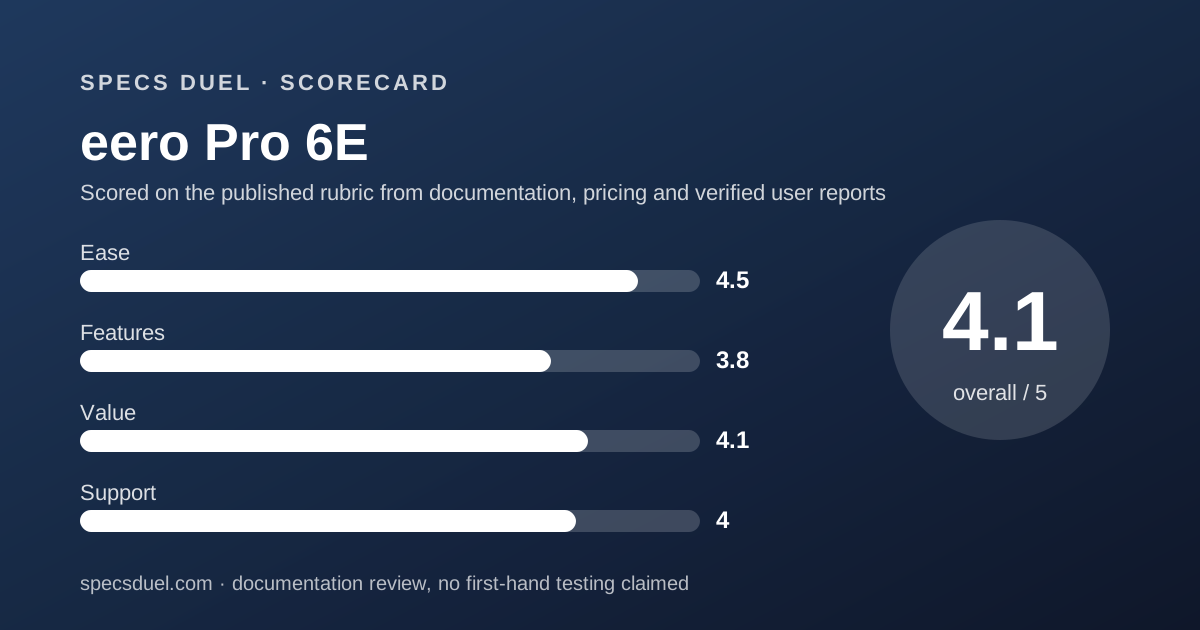
Scored on the published rubric, from documentation, pricing and verified user reports.
Best for: A buyer who wants a price, a return window and a warranty term on one page, plus a 2.5 gigabit port on every unit, and who does not need band-by-band radio figures to make the decision.
Verdict
The eero Pro 6E sheet is the shortest in this cluster and the only complete one commercially. eero publishes three pack prices, a 30 day return window, a one year limited warranty, free shipping and free support on the same screen. It publishes tri-band concurrent 2:2:2 Wi-Fi 6E with 160 MHz support on 5 GHz and 6 GHz, one auto-sensing 2.5 GbE port and one auto-sensing gigabit port per unit, a 1 GHz dual-core processor with 1 GB RAM and 4 GB flash, a 139 x 139 x 55.23 mm body, a 27 W external supply and an operating range of 0 C to 40 C. What it will not publish is a per-band speed table. There is one combined claim of up to 2.3 Gbps and nothing underneath it. This is a documentation review built from the shop page rendered in a headless browser on October 28, 2026, plus eero's North America limited warranty document. Nobody here set one up.
Visit eero Pro 6E
We have no affiliate relationship with this vendor. Link goes to the official site.
Where it is strong
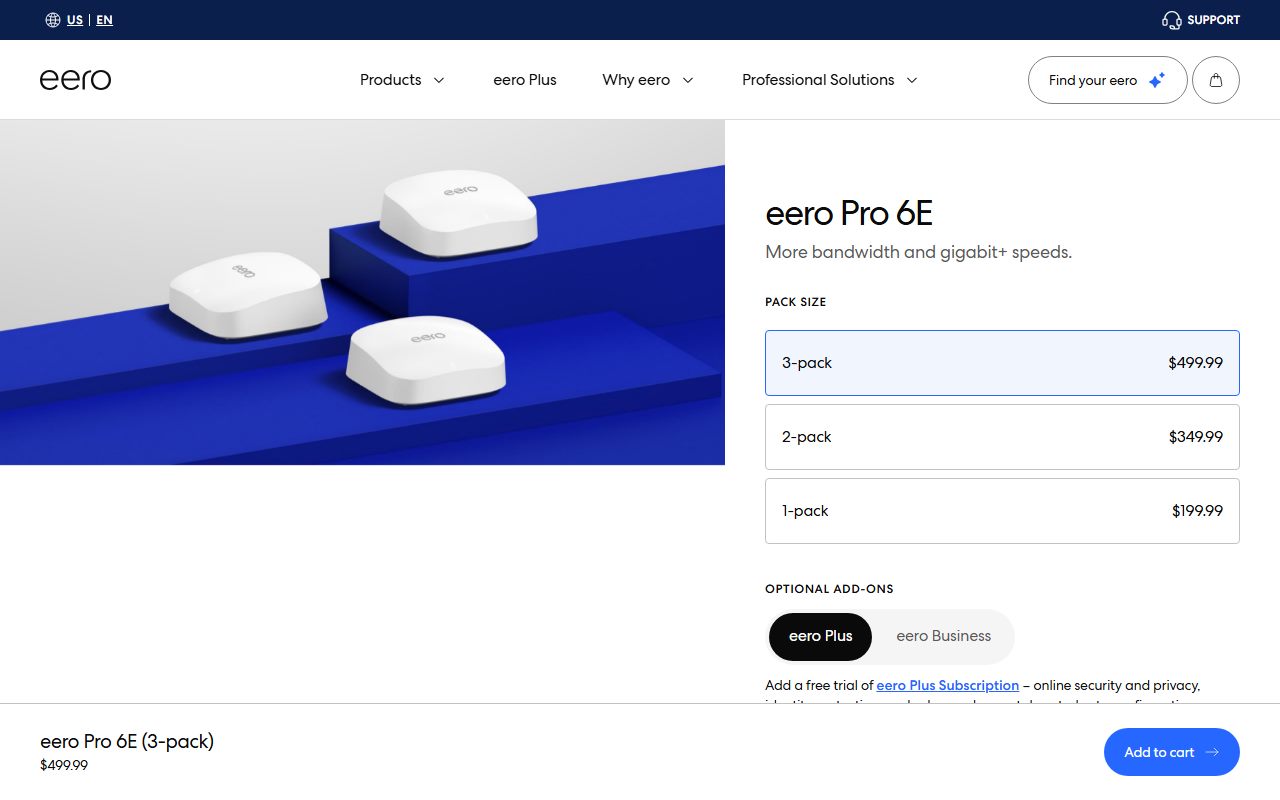
- Prints the price three ways by pack size, and the same three figures appear again in the page product markup
- One auto-sensing 2.5 GbE port on every unit, the only port faster than a gigabit anywhere in this cluster
- Publishes processor, RAM and flash together: 1 GHz dual-core, 1 GB RAM, 4 GB storage
- States warranty, returns, shipping and support on the product page rather than behind a support article
- Acts as a Thread and Zigbee smart home hub with Alexa, and as a Matter controller, all named on the page
- Gives a power figure and an electrical range, 27 W external supply at 100 to 240 V, 50 to 60 Hz
Where it falls short
- No per-band speed table at all; the page gives one combined 2.3 Gbps claim and no 2.4 GHz, 5 GHz or 6 GHz figures
- No antenna count and no weight on the page we rendered on October 28, 2026
- WPA3 is labelled an eero Labs feature rather than a plain supported standard
- Lowest coverage claim in this cluster at up to 6,000 sq ft for three units, against 7,200 and 7,500
- The one year warranty is the shortest readable term here, and eero's own document reserves three years for newer products
At a glance
| Wi-Fi standard | Wi-Fi 6E, tri-band concurrent 2:2:2 (802.11ax), 160 MHz channel support on 5 GHz and 6 GHz, backward compatible with older standards |
|---|---|
| Per-band rates | Not published on the page rendered October 28, 2026 |
| Combined speed claim | Up to 2.3 Gbps, stated as up to a gigabit wired plus up to 1.6 Gbps wireless |
| Wired connectivity | One auto-sensing 2.5 GbE and one auto-sensing Gigabit Ethernet port per unit, usable for WAN or LAN |
| Processor, memory, storage | 1 GHz dual-core processor, 1 GB RAM, 4 GB flash storage |
| Coverage claim | Up to 2,000 sq ft per unit; up to 6,000 sq ft for the 3-pack |
| Device claim | 100+ connected devices |
| Smart home | Thread and Zigbee through Alexa, Matter as a controller only, Bluetooth Low Energy 5.0, Amazon Frustration-Free Setup |
| Security and services | WPA3 (listed as an eero Labs feature), WPA2, TLS v1.2+, VPN passthrough, IPv6, NAT, UPnP, port forwarding, DHCP, static IP, cloud connectivity |
| Dimensions | 139 x 139 x 55.23 mm (5.50 x 5.50 x 2.20 in) |
| Weight | No figure on the page rendered October 28, 2026 |
| Antenna count | No figure on the page rendered October 28, 2026 |
| Power | 27 W external supply; 100 to 240 V AC, 50 to 60 Hz |
| Operating environment | 0 C to 40 C (32 F to 104 F) |
| Setup requirement | Internet service, a modem if the service needs one, and a supported iOS or Android device |
| Returns | 30 day returns, stated on the product page |
| Warranty | 1 year limited; eero's North America warranty document reserves a three year term for eero Outdoor 7, Max 7, Pro 7, eero 7, Signal and PoE 7 |
| Optional subscription | eero Plus at $9.99 a month after a one month trial, or $99.99 a year, which the page also states as $8.33 a month, after a two month trial |
| Price | $199.99 one unit, $349.99 two units, $499.99 three units, read October 28, 2026 |
| Pricing note | $199.99 / $349.99 / $499.99 by pack size on eero.com, matched by the same three figures in the page product markup (read October 28, 2026) |
What the eero Pro 6E actually is
The eero Pro 6E is a tri-band Wi-Fi 6E mesh unit sold in packs of one, two and three. The units are identical, and any one of them can be the gateway.
The radio description is one line: tri-band concurrent 2:2:2 on 802.11ax, with 160 MHz channel support on 5 GHz and 6 GHz, backward compatible with older standards.
That 2:2:2 notation means two spatial streams on each of the three bands. It is a real specification, and it is the closest this page comes to a radio table.
The wired side is where the sheet earns its place. One auto-sensing 2.5 GbE port and one auto-sensing gigabit port on every unit, either usable for WAN or LAN.
The unit also works as a smart home hub, with Thread and Zigbee through Alexa, Matter as a controller only, and Bluetooth Low Energy 5.0.
Who this sheet is for
This sheet suits a buyer who wants the commercial terms and the port speed settled in one read:
- Someone on an internet plan faster than a gigabit, because this is the only kit here with a 2.5 GbE socket
- Someone starting with one unit and adding later, since a single node price is printed rather than implied
- Someone who wants the return window and warranty term before adding to cart, both of which sit on the product page
- Someone replacing a separate smart home hub, because Thread, Zigbee and Matter controller roles are named rows
- Someone in a smaller home, since the per unit claim is 2,000 sq ft and the three unit claim is 6,000
- A reader who accepts a short sheet when the rows that exist are unambiguous, as with the Cosori Pro LE 5.0-Quart air fryer
- Someone who will not buy a product whose maker hides the price, in the way our air fryer shortlist separates priced sheets from unpriced ones
One speed number where rivals print three
This is the defining gap in the sheet, and it is deliberate rather than accidental.
eero states network speeds up to 2.3 Gbps, and immediately explains the arithmetic: up to a gigabit wired and up to 1.6 Gbps wireless, used together.
There is no 2.4 GHz figure. There is no 5 GHz figure. There is no 6 GHz figure. The page does not carry an AXE class label either.
That makes the eero sheet impossible to line up row for row against a rival that prints 2402 plus 2402 plus 574, or 600 plus 2400 plus 2400.
There is an argument in eero's favour here. Per-band physical rates are theoretical ceilings that no client ever reaches, and a combined claim is arguably less misleading.
There is also an argument against. A buyer cannot tell from this page how much of the 1.6 Gbps wireless figure belongs to the 6 GHz band.
We grade documentation, not intent. A row that does not exist cannot be compared, and that costs the feature score here.
The 2.5 gigabit port is the row that dates the rivals
Every eero Pro 6E unit carries one auto-sensing 2.5 GbE port and one auto-sensing gigabit port.
Both are usable for WAN or LAN, so a buyer is not locked into one wiring layout. The gateway unit uses one port for the modem and leaves the other free.
Against that, two ports per unit is fewer sockets than either rival kit offers. One rival gives three gigabit ports on every unit; the other gives seven across the kit.
So the trade is speed against count. One faster port and one normal one, or two to three normal ones and nothing faster.
For a household with a wired desk setup behind each node, port count wins. For a household on a multi-gigabit plan, the single 2.5 GbE socket is the only thing that matters.
Coverage: the smallest claim of the three, stated two ways
eero publishes 2,000 sq ft per unit and up to 6,000 sq ft for the three unit pack.
Stating both figures is better practice than stating only the pack total, because it lets a buyer plan a two unit or four unit layout without guessing.
It is also the lowest three unit claim in this cluster, behind 7,200 sq ft and 7,500 sq ft on the rival sheets.
The device claim is 100 or more connected devices, which sits between the 75 and the 200 claimed by the other two makers.
None of these three numbers is a measurement. They are maker claims under maker assumptions, and the only safe use for them is ranking kits within one brand's range.
Price is the row only eero fills
Of the three mesh sheets graded in this cluster, this is the only one that prints a price at all.
$199.99 for one unit. $349.99 for two. $499.99 for three. All three strings appeared as visible text and again inside the page product markup on October 28, 2026.
Two independent strings carrying the same three figures is the standard we want before printing a price, and this page meets it.
The arithmetic is ours, not eero's: a three pack at $499.99 works out to $166.66 a unit, against $199.99 for a single node and $174.99 a unit in the two pack.
So the pack discount is real but modest, around 17 percent per unit between the single and the three pack.
The page also prices the optional eero Plus subscription at $9.99 a month after a one month trial, or $99.99 a year, which the page itself restates as $8.33 a month, after a two month trial.
Ease of use: what the 4.5 is built from
This is the highest ease score in the cluster, and it comes from what the page commits to rather than from any impression of the app.
Setup requirements are stated plainly: internet service, a modem if the service needs one, and a supported iOS or Android device.
Amazon Frustration-Free Setup is named as a supported path, which means the unit can be provisioned without typing network credentials on some Amazon accounts.
The page states that any unit can be the gateway, and that gateway duty is assigned by which unit gets the modem cable, rather than by model.
Against it: the same FAQ warns that mixing eero Pro 6E with older generation eero units may reduce performance across the network, and recommends matching generations.
Features: what the 3.8 is built from
This is the lowest feature score in the cluster, and it reflects row count rather than capability.
The security list is reasonable: WPA2, TLS v1.2+, VPN passthrough, IPv6, NAT, UPnP, port forwarding, DHCP, static IP and cloud connectivity, plus profiles for per-person controls.
WPA3 appears with a qualifier attached: eero Labs feature. eero Labs is the opt-in programme for features that are not fully general, so this is not the same statement as a plain WPA3 row.
Absent rows include antenna count, weight, transmit power, certification marks, guest network structure and any VPN server function.
Present and welcome are the power rows, which almost no mesh page carries: a 27 W external supply and an electrical range of 100 to 240 V at 50 to 60 Hz.
The smart home block is the strongest part of the list, naming Thread, Zigbee, Matter as a controller only and Bluetooth Low Energy 5.0 as separate items.
Value: what the 4.1 is built from
Value is the one score this sheet can be graded on properly, because the price is actually there.
At $499.99 the three pack covers a claimed 6,000 sq ft, which is $0.083 per claimed square foot. That calculation is ours, and it is only meaningful against another priced sheet.
Neither rival in this cluster prints a price, so there is no like-for-like comparison to make on the maker pages.
What tilts the score positive is the entry point. A single $199.99 unit is a legitimate way to start, and the page sells it as such rather than treating single nodes as add-ons.
What tilts it negative is the subscription. eero Plus at $99.99 a year is presented as an add-on at checkout, and parental controls and security features sit behind it.
Support: what the 4.0 is built from
The commercial terms here are the clearest in the cluster, and the warranty term is the shortest.
The product page states a one year warranty, 30 day returns, free shipping and free support in a four item list under the pack selector.
eero's North America limited warranty document confirms the one year term for a new unopened product, and reserves a three year term for a named list that does not include the Pro 6E.
That list covers eero Outdoor 7, Max 7, Pro 7, eero 7, Signal, PoE 7 and the 30W Outdoor PoE+ adapter. The distinction is explicit rather than implied.
The document also states that a replacement is warranted for the remainder of the original period or 30 days, whichever is longer, and that original units must be returned within 30 days of receiving a return authorisation.
Support is described as available seven days a week, with no hours, channel list or response time attached.
How this sheet was read
The shop page was rendered in a headless browser on October 28, 2026 and the document was searched for strings rather than summarised.
The three prices were taken twice: once from visible text under the pack size selector, and once from the price fields in the page product markup. Both sets agreed.
The tech specs block, the returns line and the eero Plus pricing all came from that same render.
The warranty terms came from eero's North America limited warranty document, rendered the same day, which is where the three year exception list lives.
No figure here comes from a retailer listing, a search result snippet or a summary tool. Where a row is missing, this review says it could not be read on that date.
Bottom line
The eero Pro 6E has the shortest technical sheet and the most complete commercial one in this cluster.
Buy it if you want a 2.5 gigabit port, a printed price and a stated return window, and if a combined speed claim is enough for your decision.
Skip it if you compare per-band figures, antenna counts or weights, because none of those rows exist on this page.
For another category where one maker prints the commercial terms and the rival hides them, see the EcoFlow RIVER 3 Plus sheet.
For two sheets that disagreed about how to state the same number, see Levoit Core 300S against Coway Airmega AP-1512HH, with the Levoit Core 300S sheet and the Coway Airmega AP-1512HH sheet behind it.
For a dock-and-base kit judged the same way, see the ECOVACS DEEBOT N30 Pro Omni sheet.
Buy it if
- A port faster than a gigabit is required, because every unit carries one auto-sensing 2.5 GbE socket
- You want the commercial terms on the product page, since price, returns, shipping, support and warranty all sit on one screen
- The kit doubles as a smart home hub, with Thread, Zigbee, Matter as a controller and Bluetooth Low Energy 5.0 named on the page
- You are buying one unit rather than three, because $199.99 for a single Wi-Fi 6E node is the only entry price any maker in this cluster prints
Skip it if
- Per-band radio figures are the decision, because this page publishes none and gives one combined number instead
- You compare antenna counts and weights, neither of which appears anywhere on this page
- A longer warranty matters, since one year is the shortest readable term in this cluster and eero reserves three years for other models
Frequently asked
How much does the eero Pro 6E cost?
$199.99 for one unit, $349.99 for two and $499.99 for three on eero.com, read October 28, 2026. The same three figures appear in the page product markup, so two independent strings agree.
How fast is the eero Pro 6E?
eero publishes one figure: up to 2.3 Gbps, described as up to a gigabit wired plus up to 1.6 Gbps wireless. It does not publish separate 2.4 GHz, 5 GHz and 6 GHz rates the way rival mesh pages do.
Does the eero Pro 6E have a 2.5 gigabit port?
Yes. Each unit carries one auto-sensing 2.5 GbE port and one auto-sensing gigabit port, and either can serve as WAN or LAN. It is the only port above a gigabit in this cluster of three mesh sheets.
What is the eero Pro 6E warranty?
One year limited, stated on the product page and in eero's North America warranty document. That document reserves a three year term for eero Outdoor 7, Max 7, Pro 7, eero 7, Signal and PoE 7, which does not include this model.
How much area does the eero Pro 6E cover?
Up to 2,000 sq ft per unit and up to 6,000 sq ft for the three unit pack, per the product page read October 28, 2026. That is the lowest three unit claim of the mesh sheets graded in this cluster.
Does the eero Pro 6E support WPA3?
The page lists WPA3 with the qualifier eero Labs feature, alongside plain WPA2. eero Labs is the company's opt-in feature programme, so WPA3 is presented differently here than on rival pages that simply list it.
Can I return an eero Pro 6E?
The product page states 30 day returns, alongside free shipping, free support and the one year warranty. The terms sit in a short list under the pack size selector rather than in a separate policy page.
Sources
- eero Pro 6E shop page (pack prices, tech specs block, wired connectivity, processor and memory, dimensions, power, operating range, coverage and device claims, returns and warranty line, eero Plus pricing) - checked October 28, 2026
- eero Limited Warranty, North America (one year default term; three year term listed only for eero Outdoor 7, Max 7, Pro 7, eero 7, Signal, PoE 7 and the 30W Outdoor PoE+ adapter) - checked October 28, 2026
Update history
- October 28, 2026 - First publication. Shop page and North America limited warranty document both rendered in a headless browser on October 28, 2026; prices confirmed against the page product markup.
Visit eero Pro 6E
We have no affiliate relationship with this vendor. Link goes to the official site.