 Specs

EcoFlow RIVER 3 Plus
The smallest sheet in this cluster, the fastest UPS switchover, and the only one whose charge time sits inside the specification row itself
Scored on the published rubric, from documentation, pricing and verified user reports.
Best for: A desk, a router cupboard or a weekend bag where 286Wh is enough and an under 10 ms switchover matters more than inverter size.
Verdict
The EcoFlow RIVER 3 Plus is the only sheet in this cluster that ties its charge time to a stated input power inside the specification row, and the only one with a switchover figure in single-digit milliseconds. EcoFlow publishes 286Wh, LiFePO4 at 3000 cycles to 80% capacity, 600W across three AC outlets with a 1200W surge and a 1200W X-Boost mode, two 12W USB-A ports totalling 24W, one 100W USB-C, AC input at 380W charging 0-100% in 60 minutes, 220W of solar input charging in 1.5 hours, car input at 220W over 3.3 hours, UPS switchover under 10 ms, noise under 30 dB, 9.2 x 9.1 x 5.8 inches and 10.4 lb. This is a documentation review from the us.ecoflow.com product page rendered in a headless browser on October 24, 2026, plus the EcoFlow US warranty policy table. Nothing was plugged in. The product page prints no warranty row at all, and every figure on it carries an internal-testing footnote.
Visit EcoFlow RIVER 3 Plus
We have no affiliate relationship with this vendor. Link goes to the official site.
Where it is strong
- UPS switchover printed as under 10 ms, half the figure on either rival sheet
- Every charging row ties a time to a stated input power: 380W in 60 minutes, 220W solar in 1.5 hours, 220W car in 3.3 hours
- Noise printed as a specification row, under 30 dB, with a footnote naming the test room temperature
- 10.4 lb and a 9.2 x 9.1 inch base, about 84 square inches, the smallest footprint in this cluster
- Expandable to 858Wh with either the EB300 at 286Wh or the EB600 at 572Wh, both named in the page copy
- Five-year warranty for this exact model in the EcoFlow US warranty policy table
Where it falls short
- No warranty row anywhere on the product page; the five-year figure had to be read from a separate policy table
- 600W continuous is the smallest inverter here, and 286Wh is a quarter of what either rival publishes
- About $1.05 per watt-hour by our arithmetic, roughly double the cost per watt-hour of either kilowatt-hour sheet
- No car or 12V output row of any kind, where both rival sheets print one
- The IP54 rating applies only to the battery pack, per the page's own footnote, not to the whole unit
- The price block prints a sale badge, a sold-out badge and a saving of minus zero dollars all at once
- Only one published owner review, and every performance figure on the page carries an internal-testing disclaimer
At a glance
| Capacity | 286Wh |
|---|---|
| Battery chemistry | LiFePO4, 3000 cycles to 80% capacity |
| AC continuous output | 600W total across 3 outlets |
| AC surge output | 1200W surge, plus a 1200W X-Boost mode |
| AC outlets | 3 |
| USB and DC outputs | 2x USB-A at 12W max each, 24W total; 1x USB-C at 100W max; no car or 12V output row printed |
| AC input | 100-120V, 10A max, 50/60Hz, 380W, 0-100% in 60 min |
| Solar input | 220W, 0-100% in as fast as 1.5 hr |
| Car input | 220W, 11-55V, 0-100% in 3.3 hr |
| Generator input | 100-120V, 10A max, 50/60Hz, 380W, 0-100% in 60 min |
| UPS switch time | Under 10 ms |
| Noise | Under 30 dB, lab tested at 89.6F per the page footnote |
| Expandable to | 858Wh with the EB300 (286Wh) or the EB600 (572Wh) |
| Operating range | Optimal 68 to 86F; charge 32 to 113F; discharge 14 to 113F; storage 68 to 86F |
| Ingress protection | IP54 on the battery pack only, per the page footnote |
| Dimensions | 9.2 x 9.1 x 5.8 in |
| Weight | 10.4 lb |
| Certification | No UL, ETL or standard number appears in the rendered page |
| Warranty | 5 years for RIVER 3 Plus per the EcoFlow US warranty policy table; no warranty row on the product page |
| Price | $299.00, read October 24, 2026 |
| Pricing note | $299.00 on us.ecoflow.com, confirmed in the page markup as data-price 29900 and product:price:amount 299.0 (read October 24, 2026) |
What the EcoFlow RIVER 3 Plus actually is
The RIVER 3 Plus is a 286Wh LiFePO4 power station with a 600W inverter, three AC outlets and a body that weighs 10.4 lb. It sold for $299.00 on the read date.
It is not a competitor to the kilowatt-hour units in this cluster on capacity. It is a competitor on switchover speed and on how its specification rows are written.
This page is a documentation review.
Every figure below comes from the us.ecoflow.com product page rendered in a headless browser on October 24, 2026, plus the EcoFlow US warranty policy table and the EcoFlow US brand page for the same model.
Nothing was plugged in and nothing was measured.
Two cautions before the table. The product page carries no warranty row at all, and a footnote at the bottom of the Specs block states that every test result on the page came from EcoFlow's own internal testing.
Who the EcoFlow RIVER 3 Plus is best for
This sheet points at a job, not a household: keeping small always-on loads alive through a short cut.
- A router, a modem or a network cupboard, where the page claims 35 hours on a 3W router
- A desk with a desktop machine on it, where the page claims at least 21 minutes at 600W, enough for a clean shutdown
- Any load that cannot tolerate a 20 ms gap, given a printed switchover under 10 ms
- A bedroom or a studio, since this is the only sheet here that prints a noise row as a specification
- A small boot or a shelf, at 9.2 x 9.1 x 5.8 inches and 10.4 lb
- A buyer who may want 858Wh later, using the named EB300 or EB600 extra battery
- Who should skip it: anyone running a kettle, a heater or a power tool, at 600W continuous
- Who should skip it: anyone buying on cost per watt-hour, which is roughly double either kilowatt-hour sheet here
The numbers EcoFlow publishes, and the way the rows are written
The Specs block is shorter than either rival table but better constructed, because most rows carry their own test condition.
Capacity 286Wh. Dimensions 9.2 x 9.1 x 5.8 inches. Net weight 10.4 lb. Battery chemistry LiFePO4, 3000 cycles to 80% capacity. UPS under 10 ms. Noise under 30 dB.
AC output: 3 outlets, 600W total, surge 1200W, X-Boost 1200W. USB-A output: 2 ports at 5V 2.4A, 12W max per port, 24W total. USB-C output: 1 port, 100W max.
Inputs are the interesting part. AC input reads 100-120V, 10A max, 50/60Hz, 380W, 0-100% in 60 min. Solar input reads 220W, 0-100% in as fast as 1.5 hr. Car input reads 220W, 11-55V, 0-100% in 3.3 hr.
Generator input repeats the AC figures exactly, which is honest rather than padded.
Temperature gets four rows rather than two: optimal operating 68 to 86F, charge 32 to 113F, discharge 14 to 113F, storage 68 to 86F.
Two rows are absent. There is no warranty row and no car or 12V output row anywhere in the table.
Charging rows that carry their own input power are the best thing on this sheet
Compare three charging claims across this cluster and the difference in construction is immediate.
The Anker sheet puts 0-100% in 58 mins in its marketing bullet list, and its specification table prints only a 1300W input ceiling with no time row at all.
The Jackery sheet prints 1.58 hours in the table and 0-100% in 1 Hour in the copy above it, and never reconciles them.
This sheet prints 380W and 0-100% in 60 min inside the same cell.
A time with its input power attached is checkable. 286Wh at 380W cannot physically take less than about 45 minutes, our arithmetic, so a 60-minute figure is consistent with the row beside it.
That internal consistency is what the score rewards. It is the same quality we looked for on the Ninja Air Fryer Pro XL sheet, where 1,750 watts divided by 120 volts lands on the printed 14.6 amps.
It is also what the Dreame L40 Ultra Gen 2 sheet lacks, where the headline suction figure carries an in-house lab disclaimer and no test standard.
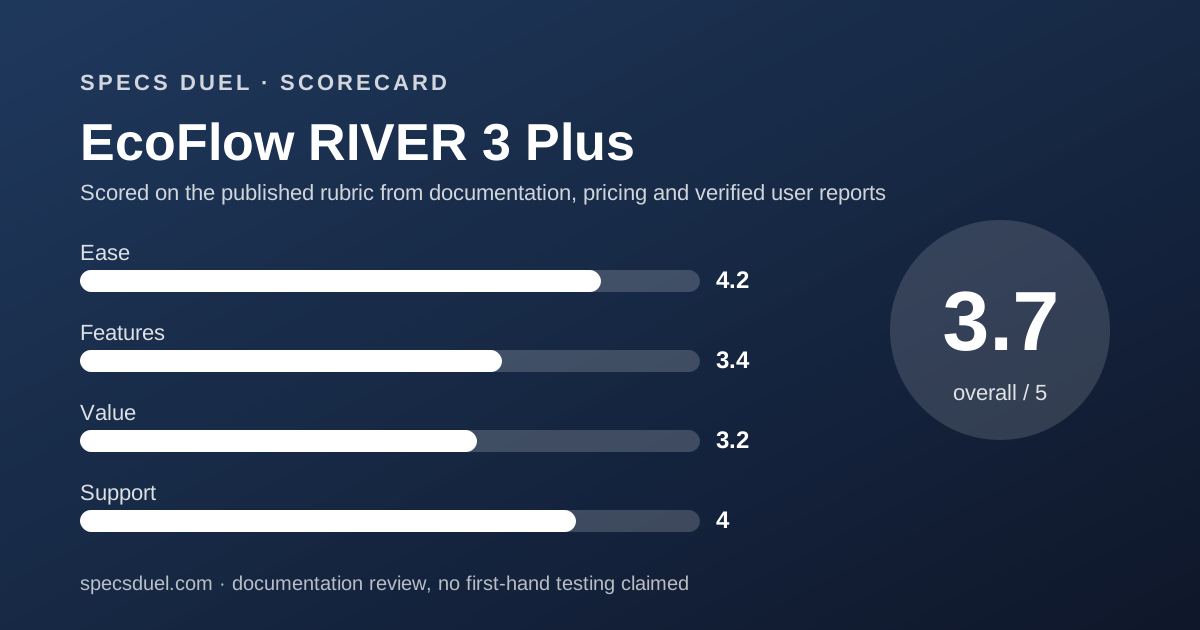
Ease of use: what the 4.2 is built from
Ease rewards a sheet that tells a buyer where the unit goes and how it behaves there.
The physical block is the smallest in the cluster and the page says what that buys: two rear AC outlets so device cables can be concealed, and an upgraded screen that shows UPS state in real time.
Four temperature rows is more than either rival gives, and the optimal operating band of 68 to 86F is a figure neither rival prints at all.
The noise row is printed as a specification rather than copy, which is the right place for it.
Deductions: there is no car or 12V output, so a cigarette-lighter accessory has no socket here. There is no app row in the Specs block, although the page copy describes app control.
The IP54 claim also needs the footnote beside it. The page states plainly that IP54 covers the battery pack and not the entire package, and that it does not prevent immersion. Printed that way it is useful; read off the badge alone it is misleading.
Features: what the 3.4 is built from
Features are graded on documented hardware, and at this capacity there is simply less hardware to document.
600W continuous across three outlets, with a 1200W surge and a 1200W X-Boost mode. The Anker sheet prints 1800W continuous and six outlets; the Jackery sheet prints 1500W continuous and a 3000W surge peak.
USB provision is three ports: two USB-A at 12W each and one USB-C at 100W. There is no second USB-C and no DC output.
Solar input of 220W is the lowest in the cluster, against 400W on the Jackery sheet and 600W with MPPT on the Anker sheet.
The expansion path is real and named: 858Wh total using either the 286Wh EB300 or the 572Wh EB600. That is a smaller ceiling than Anker's 2112Wh but better documented than Jackery's, which publishes none.
The switchover row is the feature that justifies the score at all. Under 10 ms is half what either rival publishes, and it is the row that decides whether a desktop machine stays up.
Value: what the 3.2 is built from
Value is price against published capability, and on cost per watt-hour this is the most expensive sheet in the cluster by a wide margin.
$299.00 for 286Wh is about $1.05 per watt-hour, our arithmetic on the two printed figures. The Anker sheet is about 44.5 cents and the Jackery sheet about 48.5 cents.
Per pound it is also the weakest, at about 27.5 watt-hours per pound against 37 and 45 on the two larger sheets, all three our arithmetic.
That is the honest reading of a small unit against large ones, and it is why the score sits where it does rather than lower. A buyer who needs 286Wh is not overpaying for 1070Wh they will never use.
The price block itself is untidy. Regular price $299.00, sale price $299.00, a sale badge, a sold-out badge and a total savings figure of minus zero dollars, all rendered at once.
The figure is solid: data-price 29900 in the markup and product:price:amount 299.0 in the page metadata both read $299.00. The badges are template furniture, and we report them as such rather than as a sale.
Support: what the 4.0 is built from
Support is graded on warranty length, written conditions and documentation quality, and the term here is good while its placement is not.
The product page carries no warranty row. The EcoFlow US warranty policy table does, and it lists RIVER 3 Plus at 5 years. The RIVER 3 one row above reads 24 months, so the table is model-specific rather than a blanket figure.
The EcoFlow US brand page for the same model repeats five years in prose, so two EcoFlow pages agree and the page selling the unit stays silent.
Five years matches the Anker row and beats the Jackery base term of three.
The policy page also states that the warranty period starts from the date of delivery to the original purchaser, and that registration is required for the extension on the models that offer one.
Deductions: no certification standard is named anywhere in the rendered page, the same gap as on the Jackery sheet and the opposite of the Anker page, which names four UL standards and an auditor. The page also publishes a single owner review.
For the same failure in another category, the Blueair Blue Pure 311i Max sheet prints one warranty term on its product page and a different one on its policy page.
Every performance figure here carries an internal-testing footnote, and that is a feature
At the foot of the Specs block EcoFlow prints a disclaimer most makers leave out: all test results displayed on the page are based on internal testing, subject to temperature, humidity and calibration differences, in a controlled laboratory environment.
Three numbered footnotes follow it. The runtime claims came from laboratory tests with common household appliances at normal room temperature, and the double-runtime claim specifically used low-wattage loads such as a 3W light or router.
The noise data came from laboratory tests at 89.6F. The IP54 rating covers the battery pack only.
That is more disclosure than either rival sheet in this cluster offers, and it changes how the headline claims should be read rather than cancelling them.
We treat a printed test condition as part of the row. A figure with a condition is a specification; the same figure without one is a slogan.
The method behind that rule is set out in the air purifier shortlist by room size, and it is what separated the Coway Airmega Mighty from the Levoit Core 300S on the noise row.
For the monitor version of the same problem, the ASUS ProArt PA279CRV publishes a Delta E figure and the BenQ PD2706U does not, which is why the two sheets duel row by row.
Bottom line
The EcoFlow RIVER 3 Plus publishes 286Wh of LiFePO4 at 3000 cycles to 80%, 600W across three outlets with a 1200W surge and a 1200W X-Boost mode, two 12W USB-A ports and one 100W USB-C.
It adds AC input at 380W charging in 60 minutes, 220W solar in 1.5 hours, 220W car input in 3.3 hours, switchover under 10 ms, noise under 30 dB, 9.2 x 9.1 x 5.8 inches and 10.4 lb.
All of it from the us.ecoflow.com product page read October 24, 2026, with the five-year warranty read from the separate EcoFlow US warranty policy table because the product page carries no warranty row.
On our rubric it scores 3.7 overall, third in this cluster, and the capacity gap is most of that gap.
Buy it when the load is small, always on and intolerant of a 20 ms gap. Buy one of the kilowatt-hour sheets when the load is a kettle.
Buy it if
- Switchover speed decides the purchase, at under 10 ms against under 20 ms on both rival sheets
- The unit lives on a desk or in a cupboard, at 10.4 lb and about 84 square inches of base
- You want charging figures tied to an input wattage, which is how all four input rows are written here
- A published noise figure is a requirement, since this is the only sheet here that prints one as a specification row
Skip it if
- You need to run a kettle, a heater or a power tool, because 600W continuous and 1200W surge is the smallest pair in this cluster
- Cost per watt-hour decides it, at about $1.05 against roughly 45 cents on either kilowatt-hour sheet
- You need the warranty term on the page that sells the product, because this one does not carry it
- A 12V car output is on your list, since no DC output row appears at all
Frequently asked
How big is the EcoFlow RIVER 3 Plus battery?
286Wh of LiFePO4, rated at 3000 cycles to 80% capacity, per the Specs block read October 24, 2026. EcoFlow prints no amp-hour or pack voltage figure, so the 286Wh claim cannot be cross-checked against cell arithmetic on this page.
How much power can the EcoFlow RIVER 3 Plus run?
600W total across three AC outlets, with a 1200W surge and a 1200W X-Boost mode the page describes as handling 1200W heating devices continuously. That is the smallest inverter in our power station cluster; the Anker SOLIX C1000 publishes 1800W continuous.
How fast does the EcoFlow RIVER 3 Plus charge?
The AC input row prints 380W and 0-100% in 60 minutes in the same cell, which is the only charging figure in this cluster tied to a stated input power. Solar is 220W in as fast as 1.5 hours, car input 220W over 3.3 hours.
How long is the EcoFlow RIVER 3 Plus warranty?
Five years, but not according to the product page, which prints no warranty row. The figure comes from the EcoFlow US warranty policy table, where RIVER 3 Plus reads 5 years, read October 24, 2026. The RIVER 3 in the row above reads 24 months.
Is the EcoFlow RIVER 3 Plus waterproof?
Not as a unit. The page claims IP54 battery protection, and its own footnote states the IP54 rating applies only to the battery pack, not the entire package, and does not prevent water immersion. The same block claims survival after a 3 ft fall.
How loud is the EcoFlow RIVER 3 Plus?
Under 30 dB, printed as a specification row. The footnote states the noise data came from internal laboratory tests at a room temperature of 89.6F, with no distance or load given. It is still the only noise figure printed as a row in this cluster.
What does the EcoFlow RIVER 3 Plus cost in 2026?
$299.00 on us.ecoflow.com, read October 24, 2026. The figure appears twice in the page markup, as data-price 29900 and as product:price:amount 299.0, so the two strings agree. Regular price and sale price are both $299.00 with a stated saving of zero.
Can the EcoFlow RIVER 3 Plus be expanded?
Yes, to 858Wh. The page names two extra batteries, the EB300 at 286Wh and the EB600 at 572Wh, and describes a wire-free stacking connection. The EcoFlow warranty table lists the RIVER 3 Plus Smart Extra Battery at 5 years.
Sources
- EcoFlow RIVER 3 Plus Portable Power Station product page (Specs block, price markup, internal testing footnotes, owner review count) - checked October 24, 2026
- EcoFlow US warranty policy, RIVER Series table (RIVER 3 Plus: 5 years; RIVER 3: 24 months) - checked October 24, 2026
- EcoFlow US RIVER 3 Plus brand page (five-year warranty stated in prose, 858Wh expansion) - checked October 24, 2026
Update history
- October 24, 2026 - First spec sheet. Figures from the us.ecoflow.com product page rendered in a headless browser, the EcoFlow US warranty policy table and the EcoFlow US brand page for the same model.
Visit EcoFlow RIVER 3 Plus
We have no affiliate relationship with this vendor. Link goes to the official site.