 Specs
Ninja AF181 vs Philips NA340: air fryer duel
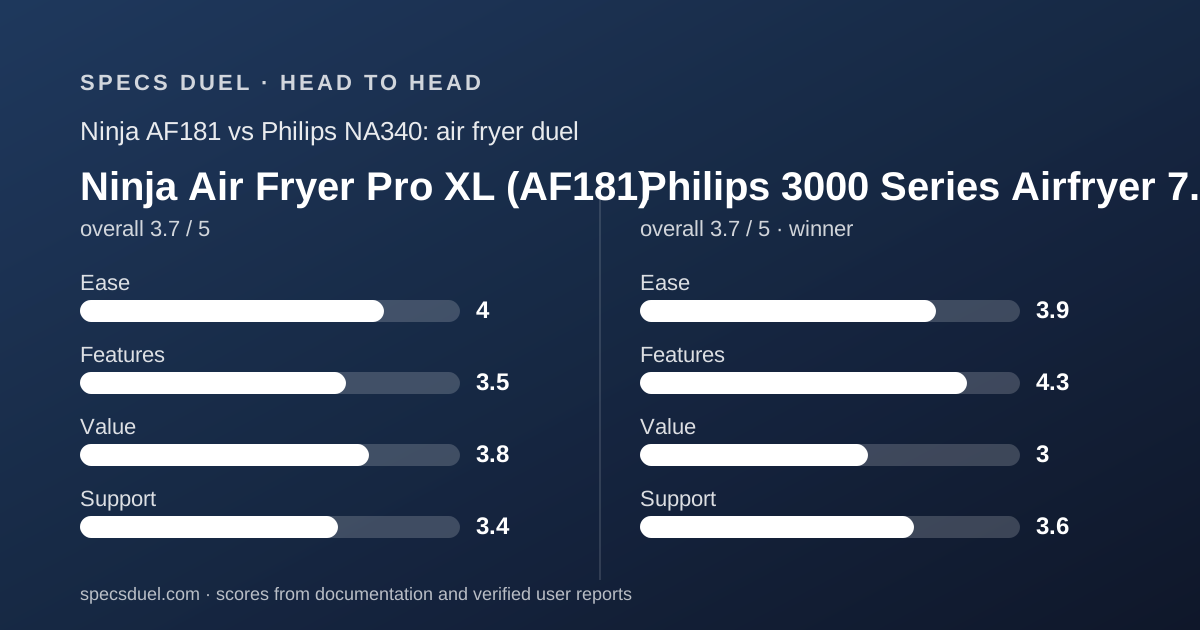
Short answer, two lines. The Ninja Air Fryer Pro XL is the pick if heat and a known price decide it: 450F, 14.6 amps printed, $179.99 and in stock on October 21, 2026. The Philips 3000 Series Airfryer 7.6 Qt is the pick if basket size and documented settings decide it: 7.6 Qt, a 104F to 392F span, a 0 to 24 hour timer, 16 named functions and two years of warranty. Our winner on the table is the Philips, because it fills eleven of our twelve standard rows against the Ninja's eight, and doubles the warranty term. It loses the one row most buyers open first: Versuni publishes no price for NA340/00 on its US page. Every figure below comes from ninjakitchen.com and usa.philips.com, including the Philips product specification API, read October 21, 2026. Neither unit was cooked in; this is a documentation duel and the column headed Difference is arithmetic on published rows.
 3.7Ninja Air Fryer Pro XL (AF181)
 3.7Philips 3000 Series Airfryer 7.6 Qt (NA340/00)
Row by row: the Philips wins capacity, dial, functions and warranty; the Ninja wins heat, electrical detail and the price row
The table above is Ninja first, Philips second, difference third.
Figures come from the ninjakitchen.com product page for AF181 with its product structured data, the SharkNinja United States returns policy, the usa.philips.com page for NA340/00, and the Philips product specification and summary APIs that feed it. All were read October 21, 2026.
Twelve rows decide a duel on this site: capacity, rated power, voltage, amperage, temperature floor, temperature ceiling, timer range, preset or function count, dimensions, weight, noise and warranty.
The Ninja fills eight. The Philips fills eleven. Neither fills noise.
Anything marked not published stayed not published after we fetched each maker's page and, in the Philips case, the specification API behind it. We did not fill a gap from a retailer listing.
Full tables sit in the Ninja Air Fryer Pro XL spec sheet and the Philips 3000 Series Airfryer 7.6 Qt spec sheet.
Capacity: the Philips holds 1.1 quarts more and costs 30 square inches of counter to do it
7.6 Qt against 6.5 QT. That is about 17 percent more basket, an editorial calculation on the two published figures.
Neither maker dimensions the basket interior, so the shape of that volume is unknown on both sheets. Ninja converts it into a food claim instead: up to 5 lbs of French fries or 9 lbs of chicken wings.
Versuni makes no food claim at all for NA340/00.
The counter cost is real. The Philips occupies 17.9 by 13.1 inches, about 235 square inches. The Ninja occupies 16.3 by 12.6, about 205. Both multiplications are ours.
Height flips the result. The Philips is 12.0 inches tall, the Ninja 14.17. If the unit lives under a wall cabinet, the bigger-basket machine is the one that fits.
For the small end of this category, the Cosori Pro LE 5.0-Quart sheet is 10.7 by 10.8 inches, about 116 square inches, roughly half the Philips footprint.
Heat: the Ninja reaches 450F, the Philips stops 58F short, and only the Philips tells you where the dial starts
This is the clearest split in the duel. Ninja prints up to 450F in Max Crisp mode. Versuni prints a range, 104F to 392F.
392F matters because most published air fryer timings are written for 400F. The Philips cannot reach that figure. The Ninja exceeds it by 50F.
The other half of the row goes the other way. Ninja publishes no minimum temperature and no range at all, so a buyer who wants to dehydrate or prove dough has nothing to check. Versuni publishes 104F, the lowest printed setting in this cluster.
Neither maker says what the non-headline functions top out at. Ninja ties 450F to Max Crisp specifically, and leaves the other five functions undefined.
So: Ninja for crisping, Philips for the slow end. Neither sheet lets you plan both.
Pricing: the Ninja prints $179.99 and the Philips prints nothing, which decides the value row before capability does
The Ninja page showed $179.99 on October 21, 2026, with its product structured data carrying the same figure and schema.org/InStock for both colour variants. Free shipping applies at $99 and above.
The Philips page showed a Where to Buy link. Not a sale price, not a suggested retail price, no figure.
We tried, in this order: the page itself, the page source downloaded directly at 1.06 MB, a headless browser render twice, two other Philips URLs for the same family, and the Philips product summary API. No price field exists in any of them.
So the duel has one priced side. We score value on the Ninja and leave the Philips value grade at the midpoint with the reason printed, rather than borrowing a retailer figure and calling it the maker's.
This is a different failure from a price you can see and cannot pay. For that case, read the Roborock Q7 Max sheet, where a $159.99 sale figure sat on an out-of-stock listing.
Electrical: the Ninja is the only one of the two that prints its amp draw, and the Philips prints a frequency its own market does not use
Ninja prints 1,750 watts, wattage peak 1,750 watts, 120 volts and 14.6 amps. Dividing 1,750 by 120 gives 14.58, which lands on the printed figure, so the rows agree.
Versuni prints 1800 W and 120 V and no amperage. The same division gives 15 amps, an editorial calculation, which is the full nameplate rating of a standard US 15 amp branch circuit.
That is the practical difference: the bigger air fryer draws more and the maker does not say so in amps. On a kitchen circuit shared with a kettle or a toaster, the arithmetic is the buyer's to do.
Then the odd row. The Philips US specification table prints Frequency 50 Hz. United States mains is nominally 120 V at 60 Hz. We print it as published and flag it rather than quietly writing 60.
Ninja publishes no frequency row at all, which is a blank rather than a contradiction. We treat a blank as missing and a contradiction as a defect.
Settings: the Philips documents 16 functions, 12 presets and a 24 hour timer; the Ninja documents six functions and no timer at all
Versuni names every function: cook from frozen, stew, bake, fry, stir-fry, saute, reheat, ferment, roast, grill, toast, dehydrate, one-pot cooking, keep warm, defrost and confit. Sixteen, with 12 counted as presets.
That gap of four between functions and presets is informative: four of the sixteen are manual time-and-temperature settings rather than buttons.
Ninja names six: Max Crisp, Air Fry, Air Roast, Bake, Reheat and Dehydrate. It publishes no timer range, so the maximum run length of that Dehydrate function is not a figure a buyer can check.
The Philips timer runs 0 to 24 HR. For context, the Cosori Pro LE sheet prints 1 to 60 min, which rules out overnight dehydrating on that unit and is at least printed.
Both units have digital panels. Only the Philips sheet lists an LED screen, a cooking window and an app, HomeID, as specification rows.
Support: the Philips doubles the warranty term, the Ninja is the only one with a stated return window
One year against two. Ninja states it twice on its product page, as the line One (1) Year Limited Warranty and as the table row Warranty (years): 1. Versuni states 2 years in the Service section of the specification table.
For a sealed appliance with a fan, a heating element and a thermostat, warranty length is the row we weight hardest, and a doubled term is the largest durable difference in this duel.
The Ninja gets the row back on returns. The SharkNinja United States policy is a 60-Day Returns, Refunds and Exchanges Policy, advertised as a 60-day money-back guarantee. That covers the early-failure window better than a warranty claim does.
Versuni states no return window, because there is no cart. A buyer takes whichever retailer's policy applies, and that is not a row the maker owns.
For how we grade a warranty that is printed at two different lengths in two different places, read the Blueair Blue Pure 311i Max sheet and the Levoit against Coway duel.
Published owner scores: three numbers for two products, and one page that disagrees with itself
The Ninja page body displayed 4.7 from 581 reviews. The product structured data embedded in that same page carried 4.405 from 121 reviews. Both read on October 21, 2026.
The Philips product summary API returned 4.81 from 129 reviews, a single figure with no competing version.
We print all three and rank on none. A rating that differs between what a shopper sees and what a search engine is handed is a documentation defect, and a 129-review sample is not a verdict.
We also do not import retailer star averages, because retailer pages mix model years and sellers. A maker-hosted figure is at least one the maker stands behind.
For the same problem in a different category, the eufy X10 Pro Omni sheet prints its dimensions two different ways on one page.
Cleaning, cords and what is in the box: the rows that decide where each unit lives
Both makers state dishwasher-safe parts, but in different places. Ninja puts it in the feature copy, nonstick and dishwasher-safe crisper plate and basket. Versuni puts Dishwasher safe in the Product features specification row, which is the stronger statement of the two.
Neither names the basket coating. Neither publishes a PFAS or PTFE position for these models. Ninja does make a PFAS and PTFE claim on the AF181 page, but for the Crispi glass system in its upsell carousel, not for this air fryer.
The cords are effectively the same length and both are short. Ninja prints 31.2 inches. Versuni prints 2.63 ft, which is 31.6 inches. Outlet position decides placement on either unit.
In the box, Ninja lists the 6.5-qt nonstick basket, the crisper plate and 20 recipes. Versuni lists no box contents on the US page, only four compatibility codes, HD9957, HD9959, HD9921 and HD9920, with no description of what they are.
Packed, the Philips ships in a 16 by 16 by 16 inch box at 17 lbs. Ninja publishes no packed figures. Neither publishes a preheat time, which is the row most buyers actually feel.
Choose the Ninja AF181 if, choose the Philips NA340/00 if
Three conditions each. Pick the side where two of three apply.
- Choose the Ninja if 450F is the setting you cook at, because the Philips stops at 392F and most air fryer timings assume 400F
- Choose the Ninja if you need a published price today, since $179.99 and in stock is a complete answer and Where to Buy is not
- Choose the Ninja if your kitchen circuit is crowded, because 14.6 amps is printed rather than left to arithmetic
- Choose the Philips if basket volume decides it, at 7.6 Qt against 6.5 QT, about 17 percent more
- Choose the Philips if you use the low end of the dial, because 104F with a 0 to 24 hour timer is a proving and dehydrating window the Ninja does not document
- Choose the Philips if warranty length decides it, at two years against one
How we built this duel, and what we deliberately did not rank
No tests were run. Grades come from each maker's own US product page, specification table and policy pages, read October 21, 2026, plus the Philips product APIs that feed its page.
Four rows are reported and not ranked. The fat claims, because Ninja's up to 75% less fat is tested against hand-cut deep-fried fries while the claim is worded against air frying, and Versuni's up to 90% less fat names no method at all.
Owner scores, because one of the two products publishes two of them. Noise, because neither maker publishes a figure. And basket shape, because neither dimensions the interior.
Where a maker published nothing, the cell says not published and earns nothing. Where a maker published two things that cannot both be true, we print both and treat it as a defect in the sheet.
For the same method applied to a whole cluster rather than a pair, see the mid-range robot vacuum shortlist and the air purifier shortlist by room size.
Bottom line: the Philips wins the table, the Ninja wins the purchase
On rows filled, the Philips wins 11 to 8, and it takes capacity, temperature floor, timer, function count, height and warranty. That is why it is the winner of this duel.
On rows a buyer can act on this week, the Ninja wins. It has a price, it has stock, it has 450F, it has 14.6 amps printed and it has a 60-day money-back window.
If you want the bigger basket and the fuller sheet, buy the Philips and accept that you will find the price somewhere other than the maker.
If you want heat, a known load and a known cost, buy the Ninja and accept one year of cover.
If neither basket size is right, the Cosori Pro LE 5.0-Quart sits below both at 5 qt, $89.99 and a two-year badge, with the only published noise figure in the category.
Frequently asked
Which is bigger, the Ninja AF181 or the Philips NA340/00?
The Philips, by 1.1 quarts: 7.6 Qt against 6.5 QT, about 17 percent more basket. It is also the larger body, 17.9 by 13.1 inches against 16.3 by 12.6, but the shorter one, 12.0 inches tall against 14.17.
Which air fryer gets hotter?
The Ninja, by 58F. It publishes up to 450F in Max Crisp mode; the Philips publishes a 104F to 392F range. Only the Philips publishes a minimum temperature, so the Ninja's dehydrate low setting is not a figure you can check before buying.
Which one is cheaper?
We cannot say. The Ninja was $179.99 and in stock on ninjakitchen.com on October 21, 2026. Versuni publishes no price for NA340/00 on usa.philips.com, on two other URLs for the same family, or in its product API, so the row stays not published.
Which has the longer warranty?
The Philips, at two years against the Ninja's one. The Ninja offsets that with a stated 60-day United States money-back return window; Versuni states no return window because the product page has no cart.
Do either of them publish a noise figure?
Neither. Both sheets leave the noise row blank. In this category only the Cosori Pro LE publishes anything, a claim of noise levels as low as 55dB with no test method, which is why we report it and do not rank on it.
Which one uses more electricity?
The Philips, by 50 watts: 1800 W against 1,750 W, both at 120 V. Ninja prints 14.6 amps; Versuni prints no amperage, and 1800 divided by 120 gives 15 amps, our calculation, which is the full rating of a standard US 15 amp kitchen circuit.
Visit Ninja Air Fryer Pro XL (AF181)
We have no affiliate relationship with this vendor. Link goes to the official site.
Visit Philips 3000 Series Airfryer 7.6 Qt (NA340/00)
We have no affiliate relationship with this vendor. Link goes to the official site.