 Specs

Jackery Explorer 1000 v2
The lightest kilowatt-hour sheet in this cluster, and the only one whose own cell arithmetic checks out against the printed capacity
Scored on the published rubric, from documentation, pricing and verified user reports.
Best for: A buyer who wants a full kilowatt-hour in the lightest body available here, and who will read the specification table rather than the headline charging claim.
Verdict
The Jackery Explorer 1000 v2 is the lightest sheet here per watt-hour and the only one that lets its own capacity figure be checked. Jackery publishes 30.4Ah at 35.2V DC, printed as 1070 Wh, which multiplies out to 1070.08 Wh, so the row agrees with itself. The rest: LiFePO4 cells, 4000 cycles to 70%+ capacity, 1500W rated with a 3000W surge peak across three 120V 60Hz outlets, a 100W and a 30W USB-C port, an 18W USB-A port, a 12V 10A car port, bypass mode at 1500W, AC charging in 1.58 hours, car charging in 12 hours, solar in 7.5 hours, 23.8 lb, 12.87 x 8.82 x 9.72 inches and a warranty row reading 3+2 Years. This is a documentation review from the jackery.com product page rendered in a headless browser on October 24, 2026, plus its embedded structured data. Nothing was plugged in. Two conflicts matter: the charge time and the warranty are each printed twice at different values.
Visit Jackery Explorer 1000 v2
We have no affiliate relationship with this vendor. Link goes to the official site.
Where it is strong
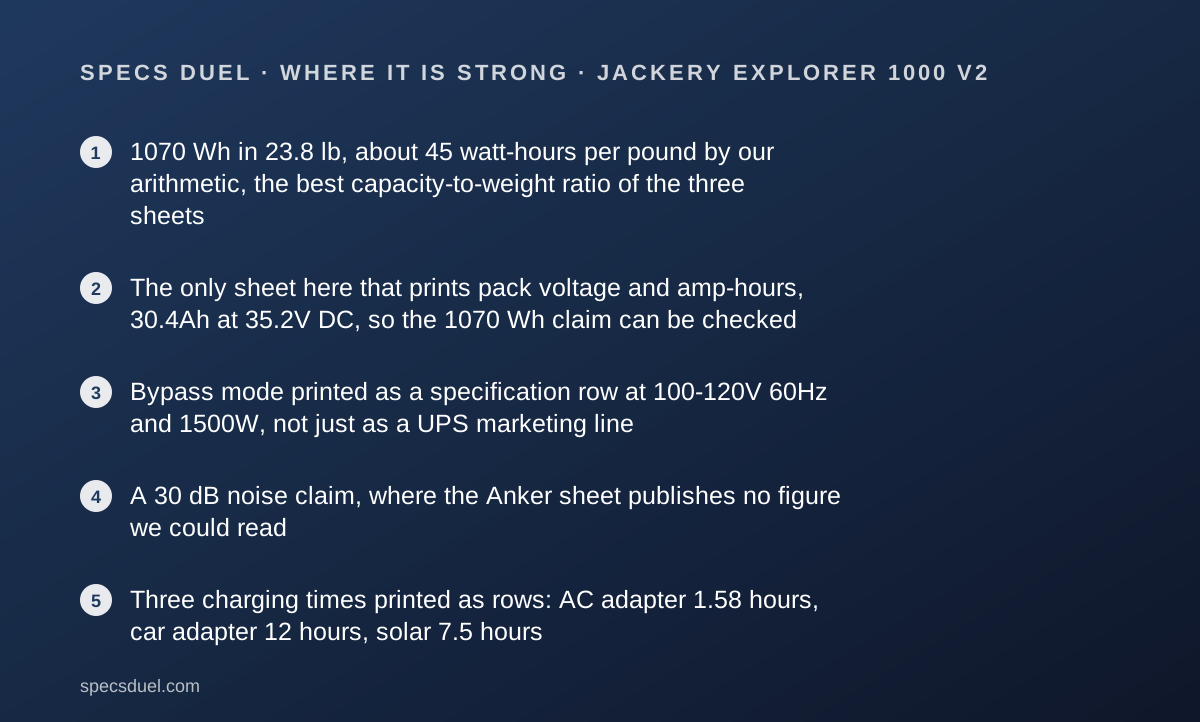
- 1070 Wh in 23.8 lb, about 45 watt-hours per pound by our arithmetic, the best capacity-to-weight ratio of the three sheets
- The only sheet here that prints pack voltage and amp-hours, 30.4Ah at 35.2V DC, so the 1070 Wh claim can be checked
- Bypass mode printed as a specification row at 100-120V 60Hz and 1500W, not just as a UPS marketing line
- A 30 dB noise claim, where the Anker sheet publishes no figure we could read
- Three charging times printed as rows: AC adapter 1.58 hours, car adapter 12 hours, solar 7.5 hours
- 476 published owner reviews averaging 4.73, by far the largest owner sample in this cluster
Where it falls short
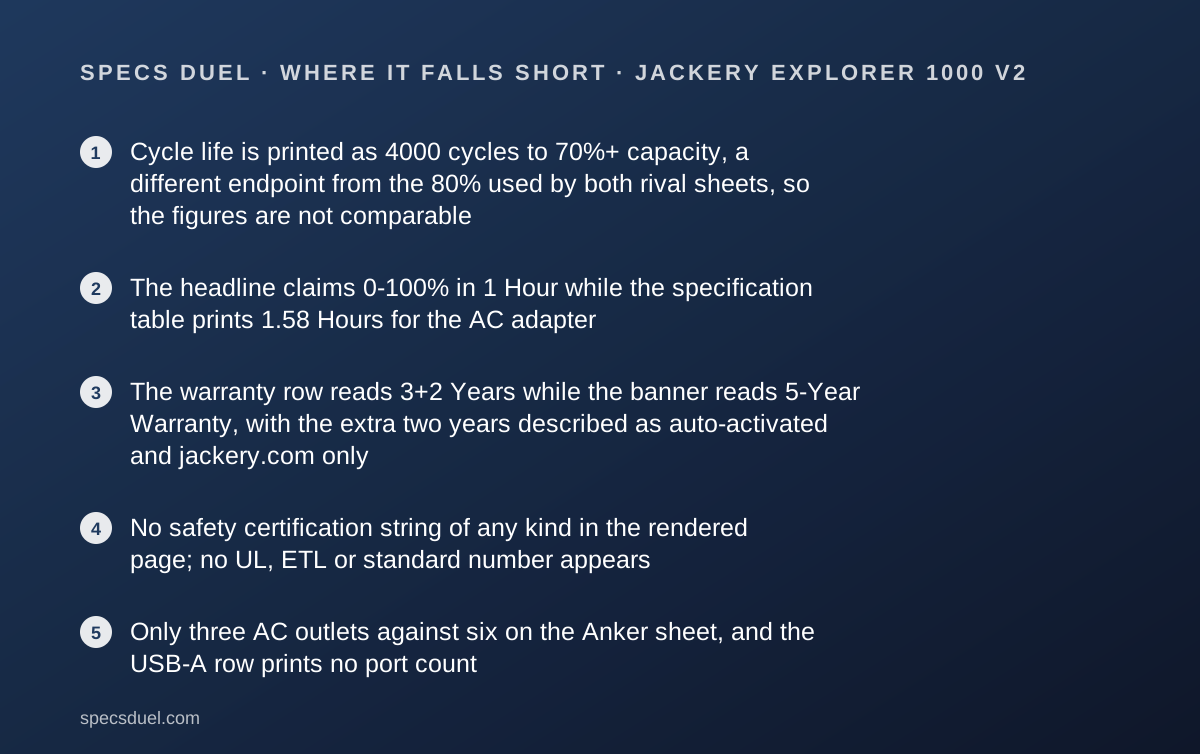
- Cycle life is printed as 4000 cycles to 70%+ capacity, a different endpoint from the 80% used by both rival sheets, so the figures are not comparable
- The headline claims 0-100% in 1 Hour while the specification table prints 1.58 Hours for the AC adapter
- The warranty row reads 3+2 Years while the banner reads 5-Year Warranty, with the extra two years described as auto-activated and jackery.com only
- No safety certification string of any kind in the rendered page; no UL, ETL or standard number appears
- Only three AC outlets against six on the Anker sheet, and the USB-A row prints no port count
- No expansion battery option printed anywhere, where both rival sheets publish one
- The 30 dB noise claim carries no distance, no load and no test method
At a glance
| Capacity | 30.4Ah at 35.2V DC, printed as 1070 Wh |
|---|---|
| Battery chemistry | LiFePO4 |
| Cycle life | 4000 cycles to 70%+ capacity (note the 70% endpoint, not 80%) |
| AC continuous output | 1500W rated |
| AC surge output | 3000W surge peak |
| AC outlets | 3, at 120V 60Hz |
| USB and DC outputs | 1x 100W USB-C, 1x 30W USB-C, USB-A at 18W max with no count printed, car port 12V/10A |
| AC input | Charge mode 100-120V 60Hz at 15A max; AC adapter charging time 1.58 hours |
| Solar input | 2x DC 8mm, 16-60V at 10.5A each, doubled to 21A / 400W max; solar charging 7.5 hours |
| UPS | Bypass mode AC input and output at 100-120V 60Hz, 1500W; switching claimed under 20 milliseconds |
| Expandable to | No expansion battery printed on this page |
| Operating range | Charge 32 to 113F (0 to 45C); discharge 14 to 113F (-10 to 45C) |
| Dimensions | 12.87 x 8.82 x 9.72 in / 32.7 x 22.4 x 24.7 cm |
| Weight | Around 23.8 lbs (10.8 kg) |
| Noise | 30 dB claimed in page copy, no distance or load stated |
| Certification | No UL, ETL or standard number appears in the rendered page |
| Warranty | Specification row reads 3+2 Years; banner reads 5-Year Warranty, jackery.com only |
| Returns | 30-day money back return stated in the trust strip |
| Price | $519.00, struck from $589.00, read October 24, 2026 |
| Pricing note | $519.00 on jackery.com, struck price $589.00, structured data price valid until October 31, 2026 (read October 24, 2026) |
What the Jackery Explorer 1000 v2 actually is
The Explorer 1000 v2 is a 1070 Wh LiFePO4 power station with a 1500W inverter, three AC outlets and a body Jackery describes as the smallest 1 kWh LFP unit it makes.
It sold for $519.00 on the read date, struck from $589.00, in Dune White and Black.
The weight row is the reason to open this sheet. 23.8 lb for a full kilowatt-hour works out to about 45 watt-hours per pound, our arithmetic, the best ratio of the three sheets in this cluster.
This page is a documentation review.
Every figure below comes from the jackery.com product page for this model, rendered in a headless browser on October 24, 2026, plus the product markup embedded in that same page.
Nothing was plugged in and nothing was measured.
Two cautions before the table. The charging time and the warranty term are each printed twice on this page at two different values.
Who the Jackery Explorer 1000 v2 is best for
This sheet points at the buyer who has to lift the unit, and who reads tables rather than banners.
- A camping or van setup where the unit is carried by hand, at 23.8 lb for 1070 Wh
- A desk or a rack where the 12.87 x 8.82 inch base matters more than the outlet count
- A short-outage plan that needs passthrough, given a bypass mode row at 1500W
- A buyer who wants surge headroom, at a 3000W surge peak against 2400W and 1200W on the rival sheets
- A buyer who wants a charge time for every input, with AC, car and solar each printed
- A buyer who reads owner data, since 476 reviews at 4.73 is the only sample in this cluster large enough to look at
- Who should skip it: anyone who needs a named certification standard, because none appears on this page
- Who should skip it: anyone who will want more capacity later, because no expansion battery is printed
The numbers Jackery publishes, and the one row that checks itself
The Tech Specs block is organised into battery, general, output, input and charging time, and it fills more rows than the EcoFlow sheet while printing fewer ports than the Anker sheet.
Battery: capacity 30.4Ah at 35.2V DC, printed as 1070 Wh. Cell chemistry LiFePO4. Cycle life 4000 cycles to 70%+ capacity.
General: weight around 23.8 lbs or 10.8 kg, dimensions 12.87 x 8.82 x 9.72 inches or 32.7 x 22.4 x 24.7 cm, charge temperature 32 to 113F, discharge temperature 14 to 113F, warranty 3+2 Years.
Outputs: three AC at 120V 60Hz, 1500W rated with a 3000W surge peak, a 30W USB-C, a 100W USB-C, a USB-A at 18W max and a car port at 12V 10A.
Inputs: charge mode AC at 100-120V 60Hz and 15A max, bypass mode AC input and output at 1500W, and two DC 8mm ports doubling to 21A or 400W maximum.
Charging times: AC adapter 1.58 hours, car adapter 12 hours, solar 7.5 hours.
The capacity row is the one worth dwelling on. 30.4 times 35.2 is 1070.08, our arithmetic, which lands on the printed 1070 Wh.
Neither the Anker sheet nor the EcoFlow sheet prints a pack voltage or an amp-hour figure, so on those two pages the capacity claim cannot be checked at all.
Where the page argues with itself: one hour against 1.58 hours
The marketing block above the buy button reads Emergency Super Charge 0-100% in 1 Hour, and a product card lower down repeats it as Emergency Charge 1 Hr.
The Tech Specs block prints AC Adapter: 1.58 Hours.
Both strings sit on the same URL and were read on the same date. A 58-minute gap between a headline and a specification row is not a rounding difference.
The likely reading is that Emergency Super Charge is a separate fast mode and 1.58 hours is the standard rate, but the page never says so, and a buyer timing a departure around the claim will pick the wrong one.
We print both figures and treat the mismatch as a defect in the sheet rather than choosing the flattering one.
The second conflict is the warranty. The specification row says 3+2 Years. The banner says 5-Year Warranty, with the extra pair described as free, auto-activated, worth $300 and available only at jackery.com.
So the enforceable base term is three years, and five is conditional on the channel.
The 4000-cycle figure is measured to 70%, not 80%, and that changes what it means
This is the single most important row on the page, and it is the one most likely to be read wrong.
Jackery prints 4000 cycles to 70%+ capacity. The Anker sheet prints 3,000 cycles to 80%+ capacity. The EcoFlow sheet prints LiFePO4, 3000 cycles to 80% capacity.
A cycle count is only meaningful with the remaining-capacity endpoint attached. Running a cell down to 70% of its original capacity takes more cycles than running it to 80% on the same chemistry.
So 4000 to 70% and 3000 to 80% are not a 33 percent advantage. They are two different tests, and the page gives no figure at the 80% mark that would allow a like-for-like comparison.
We record the endpoint in the row and we do not rank the three sheets on cycle life.
The same rule kept incompatible noise bands out of the ranking in the air purifier shortlist by room size.
For a maker publishing its own test conditions rather than hiding them, see the Cosori Pro LE sheet, which at least prints a dB claim where its rivals print nothing.
Ease of use: what the 4.4 is built from
Ease rewards a sheet that tells a buyer how the unit is carried, controlled and connected.
The weight and dimension rows are the strongest here. 23.8 lb and 12.87 x 8.82 x 9.72 inches is the smallest kilowatt-hour body in this cluster, about 113 square inches of base by our multiplication.
The page prints an LCD display and app control as features, and labels every port in a diagram: car port, USB-C1, USB-C2, USB-A, a DC/USB button, an AC button and the AC outlets.
Three charging times is more than either rival sheet gives, and the bypass row tells a buyer the unit can sit inline rather than only beside a load.
Deductions: the USB-A row prints 18W max with no port count, so the port diagram labelling a single USB-A is the only indication of how many there are.
There is also no handle or carry specification, no IP rating for the unit itself, and the page actively steers buyers to a different model with the line about a newer, more affordable option.
Features: what the 3.8 is built from
Features are graded on documented hardware, and this is the thinnest output block of the three sheets at this capacity.
Three AC outlets against six on the Anker sheet. 1500W rated against 1800W. The surge goes the other way, at 3000W peak against 2400W, which is the highest surge figure in the cluster.
Solar input caps at 21A or 400W across two DC 8mm ports. The Anker sheet prints 600W at 11-60V with MPPT. So a buyer building a larger array will hit this ceiling first.
USB provision is three ports at most: 100W USB-C, 30W USB-C and one 18W USB-A. The Anker sheet prints four, and two of them are USB-A at 12W.
The bypass row is a genuine feature and is printed as a specification rather than a badge.
The cap on the score is the missing expansion battery. Both rival sheets publish a stacking option; this one does not, so 1070 Wh is the ceiling for the life of the unit.
Value: what the 4.0 is built from
Value is price against published capability, and this sheet sits between the two rivals on every money row.
$519.00 for 1070 Wh is about 48.5 cents per watt-hour, our arithmetic on the two printed figures. The Anker sheet is about 44.5 cents and the EcoFlow sheet about $1.05.
Per pound the result flips. 45 watt-hours per pound here against about 37 on the Anker sheet and about 27.5 on the EcoFlow sheet, all three our arithmetic.
So the premium over the Anker sheet buys 4.6 lb less to carry and costs 300W of continuous output and three AC outlets.
The $589.00 struck price and the October 31, 2026 price-valid-until date in the structured data both point the same way: this is a dated promotional figure, not a standing list price.
The discount and the markup agree at 519.0 USD with InStock, so the price can be paid. That is not a given. The Philips 3000 Series Airfryer publishes no price at all, and the Roborock Q7 Max published one on an out-of-stock listing.
Support: what the 3.8 is built from
Support is graded on warranty length, written conditions and what the maker is willing to name.
The base specification row is 3+2 Years, and the conditions are printed: the extra two years are free, auto-activated, not for sale and available only at jackery.com. That is clearer than most conditional warranty copy.
The trust strip adds a 30-day money back return and 2 to 5 business days free shipping.
The deduction is the certification block, because there is no certification block. We searched the rendered page for UL, ETL and standard numbers and found none on October 24, 2026.
That is not a claim that the unit is uncertified. It is a claim that the page selling it names no standard, where the Anker page names four and an auditor.
The owner data is the strongest in the cluster: 4.73 from 476 reviews, printed both in the page body and in the embedded product markup, so the two figures agree rather than contradicting each other.
The same page carried hidden sold-out markers and a hidden notify-me button, both suppressed in the live layout, which is worth knowing before anyone reads stock state out of raw markup.
How this sheet was read, and the trap it set
Specs Duel renders the page in a headless browser, searches the raw markup, then checks the embedded structured data. On this page that third step was the one that mattered.
A search of the raw markup turned up two Sold Out strings, one under each purchase option. Both sat inside spans carrying a visually-hidden class, and a Notify Me button sat inside a container marked hidden.
So the strings exist in the template regardless of stock state, and a reader grepping for them would have reported a unit nobody could buy.
The structured data said InStock and the live Add to cart button was active. We report the unit as purchasable at $519.00 on October 24, 2026.
A page that prints a figure in markup and hides it in layout is the same class of problem as a page that prints a figure twice.
The eufy X10 Pro Omni sheet prints its dimensions two different ways, and the Blueair Blue Pure 311i Max sheet prints its warranty at two lengths.
The cluster method is set out in the mid-range robot vacuum shortlist and the duel between the eufy X10 Pro Omni and the Dreame L40 Ultra Gen 2.
Bottom line
The Jackery Explorer 1000 v2 publishes 30.4Ah at 35.2V DC as 1070 Wh of LiFePO4, 4000 cycles to 70%+ capacity, 1500W rated with a 3000W surge peak and three 120V outlets.
It adds two USB-C ports at 100W and 30W, an 18W USB-A, a 12V 10A car port, a 1500W bypass row, AC charging in 1.58 hours and 400W of solar input.
The body is 12.87 x 8.82 x 9.72 inches and 23.8 lb, and the warranty row reads 3+2 Years. All of it from jackery.com, read October 24, 2026.
It is the lightest kilowatt-hour here and the only sheet whose capacity claim can be checked against its own cell data. It is also the only one with no certification standard printed and no expansion path.
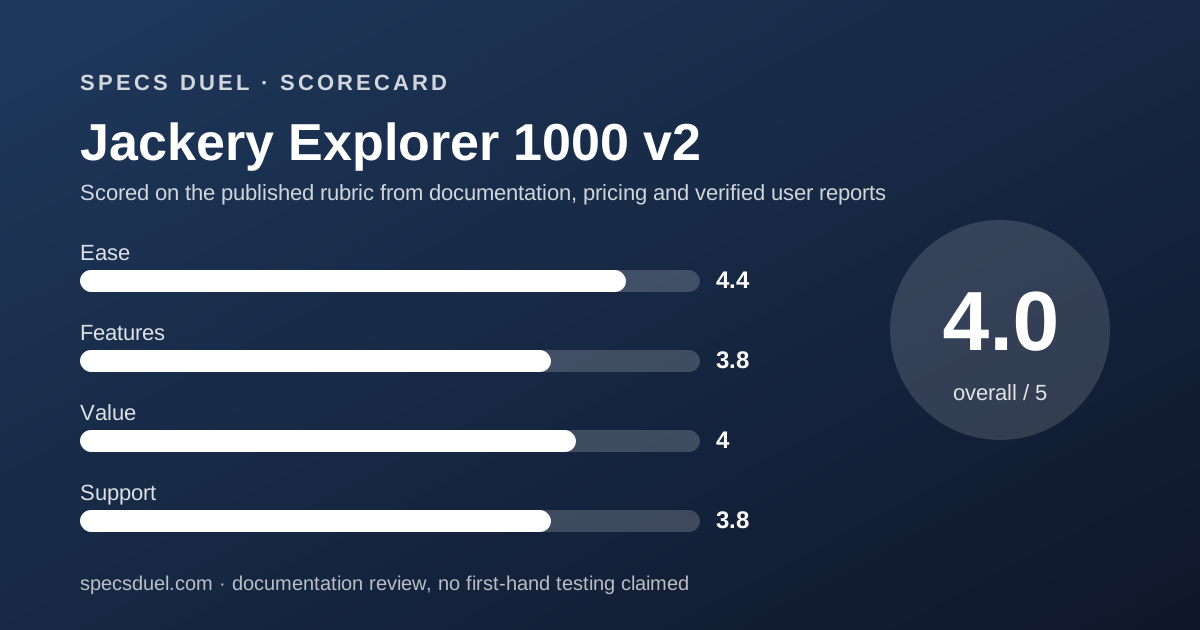
On our rubric it scores 4.0 overall, second in this cluster. Buy it for the weight, and read the Tech Specs block rather than the banner above it.
Buy it if
- Weight decides the purchase, at 23.8 lb for a full kilowatt-hour against 28.44 lb on the Anker sheet
- You want the capacity figure to be checkable, since this is the only sheet of the three that prints pack voltage and amp-hours
- A 3000W surge peak matters more than continuous rating, because that is the highest surge figure in this cluster
- You want more than one charging time in writing, with AC, car and solar each printed as a row
Skip it if
- You are comparing cycle life across brands, because this sheet measures to 70% and both rivals measure to 80%
- A named certification standard is a requirement, since none appears anywhere on this page
- Outlet count decides it, at three AC sockets against six on the Anker sheet
- The unit must grow later, because no expansion battery is printed for this model
Frequently asked
How big is the Jackery Explorer 1000 v2 battery?
30.4Ah at 35.2V DC, printed as 1070 Wh, per the Tech Specs block read October 24, 2026. Multiplying the two printed figures gives 1070.08 Wh, our arithmetic, so the capacity row agrees with the cell data beside it. Neither rival sheet in this cluster prints enough to allow that check.
How fast does the Jackery Explorer 1000 v2 charge?
The specification table prints 1.58 hours on the AC adapter, 12 hours on a 12V car adapter and 7.5 hours on solar. The marketing block on the same page claims Emergency Super Charge 0-100% in 1 Hour. Both strings were read October 24, 2026 and they do not agree.
How long is the Jackery Explorer 1000 v2 warranty?
The specification row reads 3+2 Years. A banner on the same page reads 5-Year Warranty ONLY at jackery.com, described as 3 + 2 years free, a $300 value, auto-activated and not for sale. So the base term is three years and the extra two are conditional on where the unit is bought.
Is the Jackery Explorer 1000 v2 rated for 4000 cycles?
Jackery prints 4000 cycles to 70%+ capacity. That is a different endpoint from the 3,000 cycles to 80% printed on both the Anker and EcoFlow sheets. A longer cycle count measured to a lower remaining capacity is not a better figure; it is a different test.
How loud is the Jackery Explorer 1000 v2?
The page copy says "At 30 dB, it's as quiet as a whisper", with no distance, no load and no test method printed. EcoFlow prints under 30 dB with a footnote naming an 89.6F room. Anker publishes no figure for its unit that we could read.
What does the Jackery Explorer 1000 v2 cost in 2026?
$519.00 on jackery.com on October 24, 2026, struck from $589.00. The embedded structured data carried 519.0 USD, InStock, with a price valid until date of October 31, 2026. The bundle with a SolarSaga 200W panel was $719.00, struck from $909.00.
Does the Jackery Explorer 1000 v2 work as a UPS?
The input block prints Bypass Mode AC Input/Output at 100-120V 60Hz and 1500W, and the page copy claims switching in under 20 milliseconds. That is a printed passthrough row, which is stronger than a UPS badge, but 20 ms is slower than the under 10 ms on the EcoFlow sheet.
Can the Jackery Explorer 1000 v2 be expanded?
Not on this page. No expansion battery, extra battery or stacking row appears in the specification table read October 24, 2026. The Anker sheet prints expansion to 2112Wh and the EcoFlow sheet prints 858Wh, so this is the only unit of the three with a fixed capacity.
Sources
- Jackery Portable Power Station Explorer 1000 v2 product page (Tech Specs block, price, warranty banner, embedded product markup, 476 owner reviews) - checked October 24, 2026
Update history
- October 24, 2026 - First spec sheet. Figures from the jackery.com product page rendered in a headless browser, plus the product markup embedded in that page.
Visit Jackery Explorer 1000 v2
We have no affiliate relationship with this vendor. Link goes to the official site.