 Specs
Anker SOLIX C1000 vs Jackery 1000 v2: power duel
Short answer, two lines. The Anker SOLIX C1000 is the pick if what the unit can run decides it: 1800W continuous, a 2400W surge, six AC outlets, 600W of MPPT solar input, expansion to 2112Wh and $469.99 on the read date. The Jackery Explorer 1000 v2 is the pick if what the unit weighs decides it: the same kilowatt-hour in 23.8 lb instead of 28.44 lb, with a 3000W surge peak and three charging times printed as rows. Our winner on the table is the Anker. It takes nine of our ranked rows against the Jackery's six, and it is the only one of the two that names a certification standard. It loses the documentation count 11 rows to 10, and it loses the weight row outright. Every figure below comes from ankersolix.com and jackery.com, each page rendered in a headless browser and cross-checked against its own embedded product markup on October 24, 2026. Neither unit was plugged in. This is a documentation duel, and the column headed Difference is arithmetic on published rows.
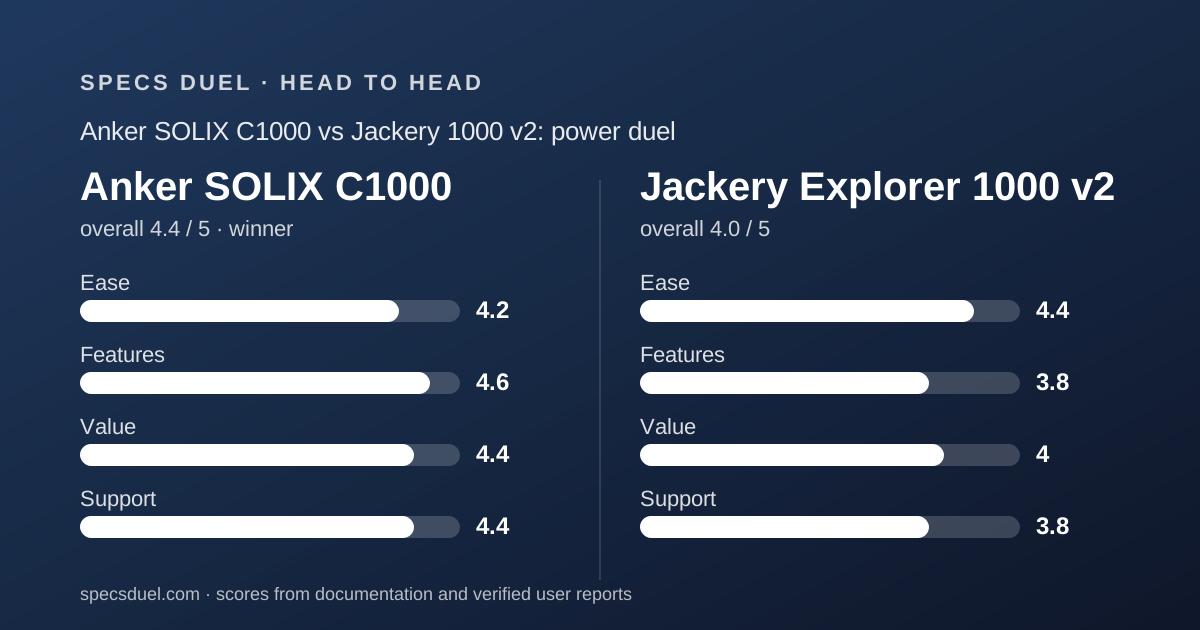
 4.4Anker SOLIX C1000
 4.0Jackery Explorer 1000 v2
Specification by specification
| Spec | Anker SOLIX C1000 | Jackery Explorer 1000 v2 | Difference |
|---|---|---|---|
| Capacity | 1056Wh | 30.4Ah at 35.2V DC, printed as 1070 Wh | Jackery +14Wh, about 1.3 percent; only Jackery prints the cell data behind the figure |
| Battery chemistry | LiFePO4 (Lithium Iron Phosphate) | LiFePO4 | same |
| Cycle life | 3,000 cycles to 80%+ capacity | 4000 cycles to 70%+ capacity | not comparable - different remaining-capacity endpoints |
| AC continuous output | 1800W pure sine wave | 1500W rated | Anker +300W |
| AC surge output | 2400W (SurgePad) | 3000W surge peak | Jackery +600W |
| AC outlets | 6 | 3, at 120V 60Hz | Anker +3 outlets |
| USB-C ports | 1x 100W, 1x 30W | 1x 100W, 1x 30W | same |
| USB-A ports | 2x 12W | 18W max, no port count printed | Anker prints a count; Jackery prints a higher per-port watt figure |
| Car / DC output | 120W, 12V/10A | 12V/10A | same rating; only Anker prints it in watts as well |
| AC input ceiling | Max. 1300W | 100-120V 60Hz, 15A max | not comparable - Anker prints watts, Jackery prints amps |
| AC charge time 0-100% | 58 mins, in the marketing bullet list only; no time row in the table | 1.58 Hours in the table; 1 Hour in the copy above it | Jackery has a row, Anker does not; Jackery's row disagrees with its own headline |
| Solar input | Max. 600W, 11-60V MPPT | 2x DC 8mm, 16-60V, doubled to 21A / 400W max | Anker +200W |
| Solar charge time | not published | 7.5 Hours | Jackery only |
| Car charge time | not published | 12 Hours | Jackery only |
| UPS switchover | Under 20 ms, printed as a specification row | Under 20 milliseconds, in copy; bypass mode printed as a row at 1500W | same order; Anker prints the time as a row, Jackery prints the passthrough wattage as a row |
| Expansion | Up to 2112Wh with an expansion battery | none printed | Anker only, +1056Wh of headroom |
| Noise | no figure we could read | 30 dB in copy, no distance, load or method | Jackery only, reported and not ranked |
| Dimensions (L x W x H) | 14.8 x 8.07 x 10.5 in | 12.87 x 8.82 x 9.72 in | Jackery footprint about 5.9 sq in smaller; Anker 0.78 in taller |
| Weight | 28.44 lb / 12.9 kg | Around 23.8 lbs (10.8 kg) | Jackery -4.64 lb |
| Watt-hours per pound | about 37.1 | about 45.0 | Jackery +7.9 Wh/lb, our arithmetic |
| Discharge temperature | -4F to 104F | 14 to 113F (-10 to 45C) | Anker floor 18F lower; Jackery ceiling 9F higher |
| Certification named | UL 1012, UL 1778, UL 1973, UL 60730, audited by SGS | none printed in the rendered page | Anker only |
| Warranty | 5-Year Warranty, in the specification table | 3+2 Years in the table; 5-Year Warranty in the banner, jackery.com only | Anker +2 years unconditional |
| Stated return window | 30-Day Money-Back Guarantee | 30-Day Money Back Return | same |
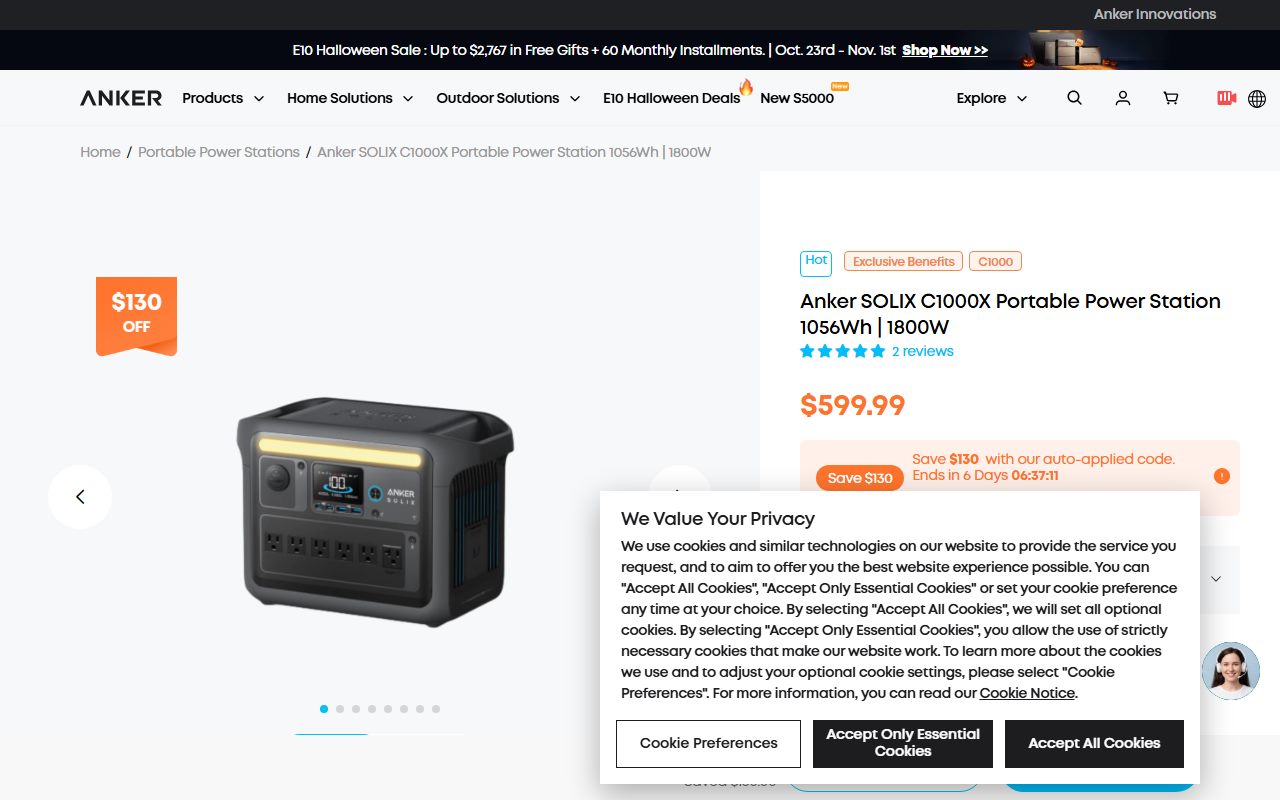
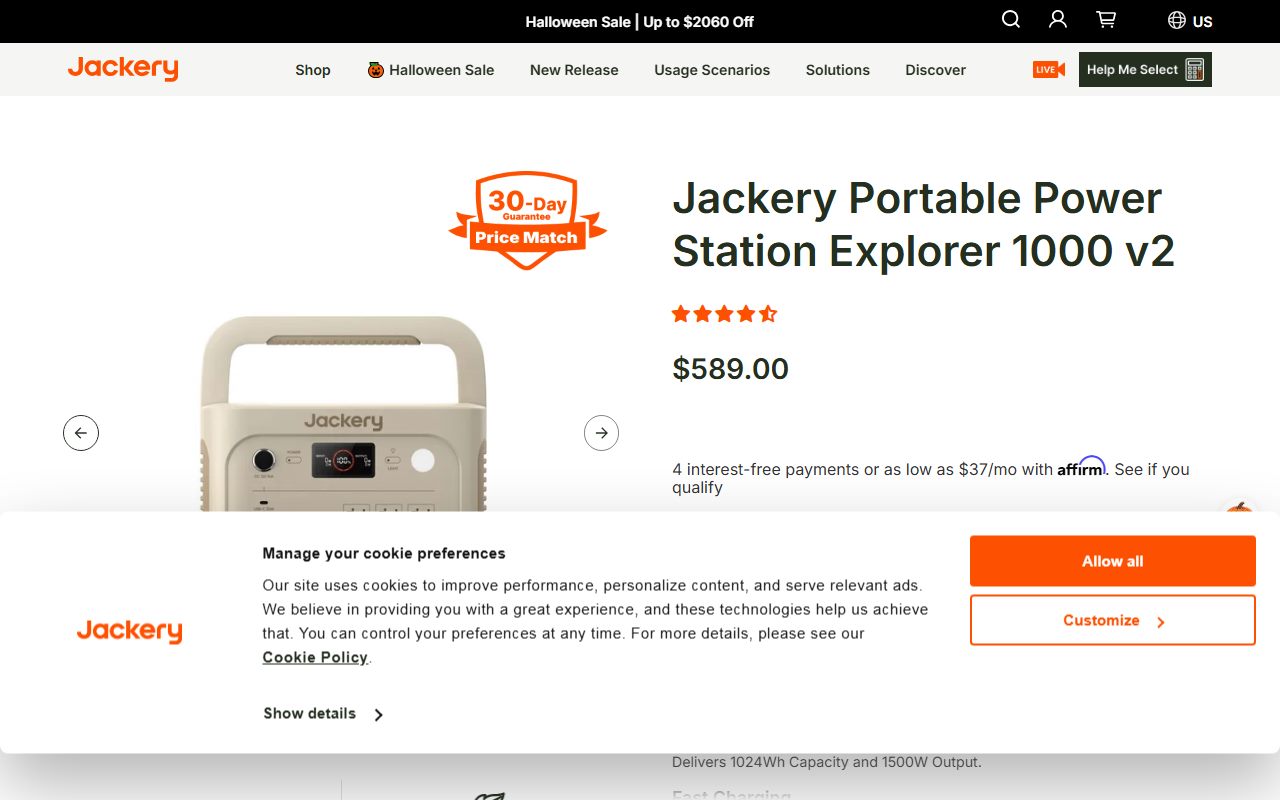
| Price (October 24, 2026) | $469.99 in cart, $599.99 list, auto-applied code | $519.00, struck from $589.00 | Anker -$49.01 at the read-date prices |
| Cost per watt-hour | about 44.5 cents | about 48.5 cents | Anker 4 cents per Wh cheaper, our arithmetic |
| Published owner score | 5.00 from 2 reviews | 4.73 from 476 reviews | Jackery on a sample 238 times larger; neither ranked |
| Rows filled of our twelve | 10 | 11 | Jackery +1 |
Row by row: the Anker wins capability, certification and price; the Jackery wins weight, surge and charge-time documentation
The table is Anker first, Jackery second, difference third.
Figures come from the ankersolix.com product page for SKU A1761111 and the jackery.com product page for the Explorer 1000 v2, each rendered in a headless browser and each cross-checked against the product markup embedded in it. Both read October 24, 2026.
Twelve rows decide a duel in this category: capacity, cell chemistry, cycle life, AC continuous output, AC surge output, port list, AC charge time, solar input, UPS switchover, noise, size and weight, warranty.
The Anker fills ten. The Jackery fills eleven. Anker misses noise and AC charge time; Jackery misses noise only, and its charge-time row contradicts its own headline.
Anything marked not published stayed not published after a headless render and a search of the raw markup. We did not fill a single cell from a retailer listing.
Full tables sit in the Anker SOLIX C1000 spec sheet and the Jackery Explorer 1000 v2 spec sheet.
Capacity is a tie; the difference is that only one of the two lets you check it
1056Wh against 1070 Wh. Fourteen watt-hours apart, about 1.3 percent, which is inside the margin of any real-world load.
So capacity is not the deciding row. How the capacity is printed is.
Jackery writes the row as 30.4Ah at 35.2V DC, printed as 1070 Wh. Multiply the two and you get 1070.08, our arithmetic, so the headline figure and the cell data agree.
Anker writes 1056Wh and nothing else. No amp-hour figure, no pack voltage, no cell count. The number is either right or wrong and the page offers no way to tell.
That is the pattern across this duel. The Anker sheet prints more capability; the Jackery sheet prints more of its own working.
For a maker printing a capacity row with no unit at all, see the Philips 3000 Series Airfryer sheet, where one basket row reads 243 with nothing after it.
Cycle life looks like a 1,000-cycle win for Jackery and is not a comparison at all
This is the row most likely to be read wrong, so it gets its own section.
Anker prints 3,000 cycles to 80%+ capacity. Jackery prints 4000 cycles to 70%+ capacity.
A cycle count without the remaining-capacity endpoint attached means nothing. Running the same cell down to 70% of original capacity takes more cycles than running it to 80%.
So 4000 to 70% against 3,000 to 80% is not a 33 percent advantage. Neither page publishes a figure at the other's endpoint, so no like-for-like number exists.
We print both rows with their endpoints and we rank neither. Treating the two as comparable would hand Jackery a win on arithmetic the makers never did.
The same rule kept three incompatible self-measured headline figures out of the ranking in the mid-range robot vacuum shortlist.
Output: the Anker runs more at once, the Jackery survives a bigger spike
The split here is clean. Anker prints 1800W continuous pure sine wave with a 2400W surge. Jackery prints 1500W rated with a 3000W surge peak.
So the Anker runs 300W more all day and the Jackery absorbs 600W more for an instant.
For most buyers the continuous figure is the one that decides, because it is the number a kettle or a space heater has to fit inside. A 1500W appliance on a 1500W inverter leaves no margin at all.
The surge figure matters for motor loads: a fridge compressor or a pump draws several times its running wattage for a fraction of a second.
Outlet count then compounds the Anker advantage. Six AC sockets against three means a 1800W budget can be split six ways without a power strip.
Neither maker publishes a per-outlet limit, so how 1800W or 1500W divides across those sockets is a row both pages leave blank.
Charging: the Jackery has a row and the Anker has a bullet, and the Jackery's row disagrees with its own headline
Neither page handles this well, in two different ways.
Anker's claim is HyperFlash AC Input, 0-100% in 58 mins, and it lives in the marketing bullet list above the buy button. The specification table prints only a 1300W input ceiling and no time row of any kind.
Jackery's table does print a time: AC Adapter 1.58 Hours. The marketing block on the same page says Emergency Super Charge 0-100% in 1 Hour, and a product card repeats it as 1 Hr.
So one page puts the figure in the wrong place and the other puts two figures 35 minutes apart in two places.
We print all three strings and rank the row to Jackery, because a contradicted specification is still a specification and a bullet point is not.
Jackery also wins the two rows Anker leaves empty: 12 hours on a car adapter and 7.5 hours on solar. Anker publishes neither.
For the better way to write this kind of row, the EcoFlow RIVER 3 Plus sheet prints 380W and 0-100% in 60 min inside the same cell, which ties the time to an input power.
Solar and expansion: the Anker takes both rows, and one of them by a wide margin
Anker prints 600W maximum solar input at 11-60V with MPPT. Jackery prints two DC 8mm ports at 16-60V, doubling to 21A or 400W maximum.
That is 200W of difference, and the voltage windows differ too. Anker accepts panels from 11V, Jackery from 16V, which matters for a single small panel rather than a string.
Expansion is not a margin, it is a presence. Anker prints expansion to a maximum 2112Wh with an expansion battery, as a specification row. Jackery prints nothing of the kind on this page.
So one of these units can double its capacity later and the other cannot, and the page selling the Jackery is silent rather than negative about it.
Taken together, these two rows decide the duel for anyone building a system rather than buying a box.
For the smaller version of the same choice, the EcoFlow RIVER 3 Plus expands to 858Wh using two named extra batteries.
Weight and size: the Jackery carries a full kilowatt-hour for 4.64 lb less
23.8 lb against 28.44 lb. That is the Jackery's clearest win and it is not close.
Converted to capacity per pound, the Jackery delivers about 45 watt-hours per pound and the Anker about 37.1, both our arithmetic on the published figures.
Footprint is near enough a tie. The Anker base is 14.8 by 8.07 inches, about 119.4 square inches. The Jackery base is 12.87 by 8.82, about 113.5. Both multiplications are ours.
Height splits them again, at 10.5 inches against 9.72. The Anker is both wider and taller.
Neither page publishes a handle specification, a carry rating or a strap option, which is a conspicuous blank on two units weighing more than twenty pounds.
Neither publishes an IP rating for the power station itself either.
Anker's page does show IP67 Outdoor Protection, but in a feature strip alongside 23% Conversion Rate and 3-Angle Adjustment, which are solar panel properties. We do not carry a claim across from a neighbouring product.
Certification: the Anker names four standards and an auditor, the Jackery names none
This is the row with the largest gap in the duel and the easiest one to verify.
Anker's own FAQ answers the question directly. Asked how many UL certifications the unit has from SGS, the page answers: four, to UL 1012, UL 1778, UL 1973 and UL 60730.
We searched the rendered Jackery page for UL, ETL and standard numbers and found none on October 24, 2026. The only matching string on the page was the word FCC inside third-party tracking code.
That is not a claim that the Jackery is uncertified. Almost every unit sold into the United States carries something. It is a claim about what the page selling it is willing to name.
For a buyer in a workplace, a rental or an insurance conversation, a named standard is the difference between a document and an assurance.
We weight this row heavily for the same reason we weight warranty heavily: it is a written commitment rather than a performance figure measured by the seller.
Support: five unconditional years against three plus two, and the same return window
Anker's specification table prints 5-Year Warranty with no qualifier on the row.
Jackery's specification table prints 3+2 Years. The banner on the same page prints 5-Year Warranty ONLY at jackery.com, and describes the extra two as free, auto-activated, worth $300 and not for sale.
So both units can reach five years, and only one of them does so from the specification row alone. A buyer who orders through a retailer rather than jackery.com should read the Jackery row as three.
The return windows match: a 30-day money-back guarantee on the Anker trust strip and a 30-day money back return on the Jackery one.
Owner data is where Jackery is far ahead on volume. 4.73 from 476 reviews, printed identically in the page body and in the embedded markup. Anker publishes 5.00 from 2 reviews, one of them written by a buyer who states the unit had not arrived.
We print all four figures and rank on none. For the same problem on one page, the Ninja Air Fryer Pro XL sheet displays 4.7 from 581 in its body and 4.405 from 121 in its markup.
Price: the Anker is $49.01 cheaper and both figures have a date attached
$469.99 against $519.00 on October 24, 2026. The Anker is cheaper by $49.01 while holding 14Wh less capacity.
Per watt-hour that is about 44.5 cents against 48.5 cents, our arithmetic on the published pairs.
Both prices are promotional and both pages say so. The Anker page shows a $599.99 list figure, a $130 saving and an auto-applied code, inside a promotion the page dates October 23 to November 1, 2026.
The Jackery page shows $519.00 struck from $589.00, and its embedded markup carries a price-valid-until date of October 31, 2026.
So neither figure is a standing list price, and a buyer reading this duel in November should expect $599.99 and $589.00 and recheck both.
Both prices can be paid. Each page's markup carried the same figure as its cart and an InStock state. That is worth stating, because the Roborock Q7 Max sheet carried a $159.99 sale figure on an out-of-stock listing.
Choose the Anker SOLIX C1000 if, choose the Jackery Explorer 1000 v2 if
Four conditions each. Pick the side where two of four apply.
- Choose the Anker if the inverter rating decides it, at 1800W continuous against 1500W, with six outlets against three
- Choose the Anker if the system will grow, because expansion to 2112Wh is a printed row and the Jackery prints none
- Choose the Anker if a named standard is required, since it lists UL 1012, UL 1778, UL 1973 and UL 60730 and the Jackery lists nothing
- Choose the Anker if the budget is the budget, at $469.99 against $519.00 and about four cents less per watt-hour
- Choose the Jackery if the unit gets carried, at 23.8 lb against 28.44 lb for the same kilowatt-hour
- Choose the Jackery if you want charge times in writing, with AC, car and solar each printed as a row
- Choose the Jackery if motor loads decide it, at a 3000W surge peak against 2400W
- Choose the Jackery if you read owner data, at 4.73 from 476 reviews against 5.00 from 2
How we built this duel, and the four rows we deliberately did not rank
No tests were run. Grades come from each maker's own United States product page, rendered in a headless browser and cross-checked against the product markup embedded in the same page, both on October 24, 2026.
Four rows are reported and not ranked.
Cycle life, because the two endpoints differ. Noise, because only one page prints a figure and it carries no method.
Owner scores, because a sample of 2 and a sample of 476 do not belong in the same column. AC input ceiling, because one page prints watts and the other prints amps.
One trap is worth recording. The raw Jackery markup contains two Sold Out strings and a Notify Me button, all inside containers marked hidden, which exist in the template regardless of stock state.
A reader grepping for those strings would have reported a unit nobody could buy. The live layout showed an active Add to cart button and the markup said InStock.
For the same method applied to a whole cluster rather than a pair, see the mid-range robot vacuum shortlist and the air purifier shortlist by room size.
Bottom line: the Anker wins the duel, the Jackery wins the walk to the car
On ranked rows the Anker takes nine: continuous output, outlet count, solar input, expansion, certification, warranty, price, cost per watt-hour and discharge temperature floor.
The Jackery takes six: weight, capacity per pound, surge peak, charge-time documentation, owner sample size and the ability to check its own capacity figure.
On documentation completeness the Jackery wins 11 rows to 10, because the Anker sheet has no charge-time row and no noise row at all.
So buy the Anker if the unit will sit in one place and run things. 1800W, six outlets, 2112Wh of headroom and four UL numbers is the stronger sheet, and it costs $49.01 less.
Buy the Jackery if the unit moves. 4.64 lb is a real difference over a trail, and it is the only one of the two whose capacity row can be checked against its own cell data.
If neither capacity is right, the EcoFlow RIVER 3 Plus sits far below both at 286Wh and $299.00, with the fastest switchover of the three at under 10 ms.
Frequently asked
Which has more capacity, the Anker SOLIX C1000 or the Jackery Explorer 1000 v2?
The Jackery, by 14 watt-hours: 1070 Wh against 1056Wh, about 1.3 percent. The useful difference is not the number but the working: Jackery prints 30.4Ah at 35.2V DC behind it, and Anker prints no cell data at all.
Which one can run more appliances at once?
The Anker, by 300W and three sockets. It publishes 1800W continuous pure sine wave across six AC outlets; the Jackery publishes 1500W rated across three. Neither page states a per-outlet limit, so how that budget divides is a blank on both sheets.
Which is lighter?
The Jackery, by 4.64 lb: around 23.8 lbs against 28.44 lb. That works out to about 45 watt-hours per pound against 37.1, our arithmetic on the published figures. Footprints are close, at about 113.5 square inches against 119.4.
Is 4000 cycles better than 3,000 cycles?
Not as published. Jackery measures 4000 cycles to 70%+ capacity and Anker measures 3,000 cycles to 80%+. Different endpoints make the counts incomparable, and neither page publishes a figure at the other's endpoint, so we rank neither.
Which one charges faster from the wall?
We cannot rank it cleanly. Jackery prints 1.58 hours in its specification table and 1 hour in its marketing copy. Anker prints 58 minutes in a marketing bullet and no time row at all, only a 1300W input ceiling. All strings read October 24, 2026.
Which one is cheaper?
The Anker, by $49.01: $469.99 against $519.00 on October 24, 2026. Both are promotional. Anker lists $599.99 beside a $130 auto-applied code, and the Jackery markup carries a price-valid-until date of October 31, 2026.
Which one has the longer warranty?
The Anker, in practice. Its specification row reads 5-Year Warranty with no qualifier. The Jackery row reads 3+2 Years, with the extra two years described in a banner as free, auto-activated and available only at jackery.com. Both state a 30-day return window.
Can either be expanded with an extra battery?
Only the Anker, to a maximum 2112Wh, printed as a specification row. The Jackery page carries no expansion, extra battery or stacking row for this model, so 1070 Wh is its ceiling for the life of the unit.
Visit Anker SOLIX C1000
We have no affiliate relationship with this vendor. Link goes to the official site.
Visit Jackery Explorer 1000 v2
We have no affiliate relationship with this vendor. Link goes to the official site.