 Specs

Fellow Aiden
The biggest carafe, the strongest heater and the smallest footprint in this cluster, sold on a temperature claim the page never puts a number against
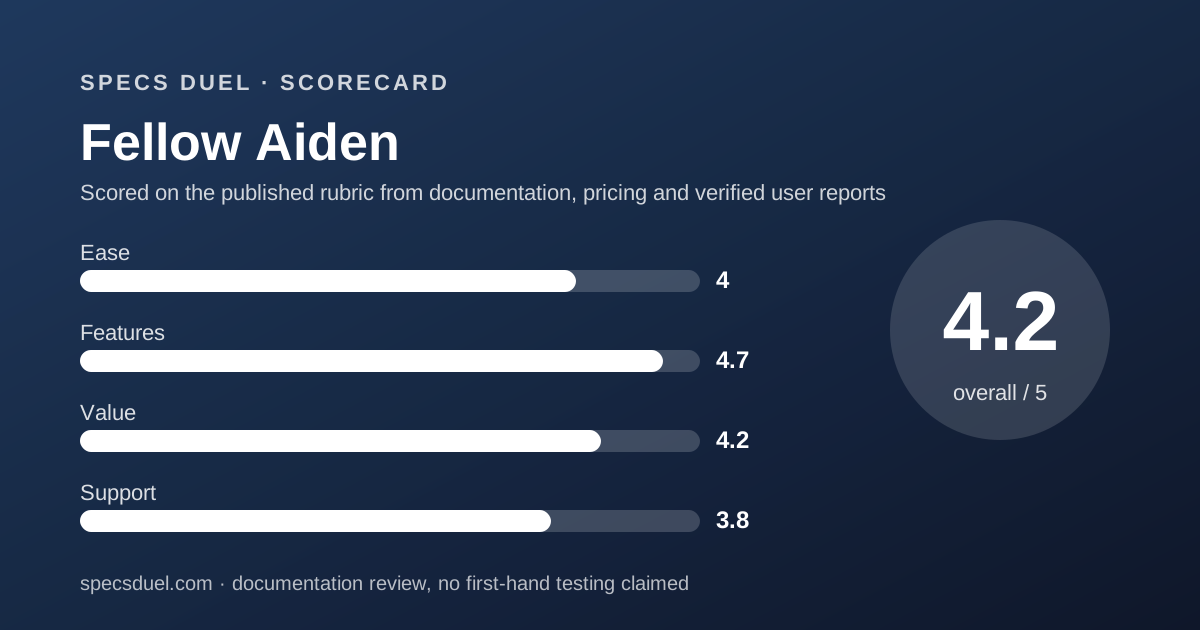
Scored on the published rubric, from documentation, pricing and verified user reports.
Best for: A buyer who wants a scheduled brew, saved recipes and the largest carafe in the group, who has limited counter width but normal height, and who accepts two years of standard cover instead of five.
Verdict
The Fellow Aiden wins the hardware rows in this cluster and loses the one row it is marketed on. Fellow publishes 110 to 120 V with 1700 W at 60 Hz, a maximum capacity of 1.5 L described as up to ten cups, 9.6 lb, a body of 8 15/16 in square by 12 in tall, a 39 in cord with integrated storage, a two year standard warranty with a paid extension option, and a materials line of food grade plastic, stainless steel and silicone. It states the machine is officially SCA certified. What it does not state is any numeric temperature range, any brew cycle time for hot coffee, or how many built-in brew profiles exist, and the headline feature on the page is to-the-degree temperature control. This is a documentation review built from that page and the separate Fellow warranty page, both rendered in a headless browser on November 1, 2026 and confirmed against independent reads of the same URLs. Nobody here brewed with one.
Visit Fellow Aiden
We have no affiliate relationship with this vendor. Link goes to the official site.
Where it is strong
- Largest carafe in the cluster at 1.5 L, about twenty percent more than either rival on published figures
- Strongest heater at 1700 W, and the lowest price per litre of rated capacity of the three sheets
- Smallest footprint here at 8 15/16 in square, and the only body under 13 in tall at 12 in
- Scheduling, saved brew profiles, notifications and firmware updates through an app on iOS and Android, with the page stating the machine works without it
- Publishes a cold brew figure: a hot-bloom slow-drip profile described as ready in 90 minutes
- Includes 15 cone and 15 flat bottom filters and names Melitta #2 and Melitta 8 to 12 cup baskets as compatible
Where it falls short
- No numeric temperature range anywhere on the page, on a machine sold on to-the-degree temperature control
- No brew cycle time for hot coffee, although a 90 minute figure exists for cold brew
- No stated count of built-in brew profiles, so the headline recipe feature cannot be sized
- Two year standard warranty, against five years on both rival sheets in this cluster
- The warranty term is on the product page as a phrase but the table that qualifies it sits on a separate page
- Extending cover past two years means buying a third party policy within 90 days of purchase
At a glance
| Maximum capacity | 1.5 L, stated as up to 10 cups |
|---|---|
| Power | 1700 W |
| Electrical | 110 to 120 V, 60 Hz |
| Weight | 9.6 lb |
| Dimensions (L x W x H) | 8 15/16 in x 8 15/16 in x 12 in (227 x 227 x 304.8 mm) |
| Cord length | 39 in (965.2 mm), with integrated cord storage |
| Carafe type | Double wall thermal carafe, described elsewhere on the page as vacuum sealed; no hotplate by design |
| Materials | High-quality BPA free food grade plastic, stainless steel, and silicone |
| Filter basket | No-drip basket that stops dripping when removed |
| Water tank | Removable, lifts out for filling and cleaning |
| Steam seal | Silicone seal stated to manage heat and moisture during brewing |
| Filters included | 15 cone filters and 15 flat bottom filters; compatible with Melitta #2 cone and Melitta 8 to 12 cup basket filters |
| App | iOS and Android, for scheduling, brew profile management, notifications and updates; the page states the machine works without it |
| Cold brew | Dedicated profile using a hot bloom and slow drip, stated as ready in 90 minutes |
| Certifications | Stated as officially SCA certified, referencing the Golden Cup recommendations |
| Warranty | 2 years standard for new generation Fellow electrics; a paid third party plan can extend to 3 or 5 years |
| Brew temperature range | No numeric range on the page read November 1, 2026 |
| Hot brew cycle time | No figure on the page read November 1, 2026 |
| Built-in profile count | No figure on the page read November 1, 2026 |
| Price | $399.95 (read November 1, 2026) |
| Pricing note | $399.95 on fellowproducts.com, read November 1, 2026; no second price appears for any variant |
What the Aiden actually is
The Aiden is a drip brewer with a full colour display, a thermal carafe and a connected app. It is the only machine in this cluster with a screen.
The brewing model is a sequence rather than a single pour. Fellow describes a dedicated bloom followed by measured pulses, with the water temperature adjusted at points through the brew.
The showerhead is adjustable and covers either a single cup or a full carafe. The water tank lifts out, the basket stops dripping when removed, and a silicone seal manages steam.
Settings are stored as brew profiles. The page says a buyer can pick a profile by roast level, follow a roaster's recommendation, or create and save their own.
There is no hotplate. Fellow states that choice plainly and gives the reason, which puts it on the same side of that argument as one of its two rivals here.
Who this sheet is for
This sheet suits a buyer who wants a brewer to hold a recipe and a schedule:
- Someone who wants coffee finished before they reach the kitchen, which no rival sheet in this cluster offers
- Someone brewing for four or more people, since 1.5 L is the largest published capacity of the three
- Someone short on counter width, because the body is under nine inches square
- Someone who will change grind and roast often and wants saved settings rather than notes
- Someone who wants cold brew without an overnight steep, with a published 90 minute figure
- A reader who already weighs connected features against warranty length, as in our eero Pro 6E sheet
- Someone who checks the maker's separate warranty table rather than trusting a phrase on the product page, as our air purifier shortlist does
The hardware rows are the best in this cluster
On the numbers Fellow publishes, the Aiden leads three of the rows a buyer actually compares.
Capacity is 1.5 L, against 1.25 L on both rival sheets. That is twenty percent more water per cycle by our arithmetic.
Power is 1700 W, against 1475 W and 1400 W. Divided by capacity, all three land between about 1120 and 1180 W per litre, so the heaters are close once volume is accounted for.
Footprint is 8 15/16 in square, or about 80 square inches, which is the smallest of the three. Height is 12 in, the only body under 13 in.
Weight is 9.6 lb, which sits between a 6.00 lb rival and a 16 lb one.
So the Aiden is the machine that fits the smallest patch of counter while making the most coffee. That combination is unusual, and it is the clearest thing this sheet proves.
The headline feature has no number attached to it
Fellow sells the Aiden on temperature control. The phrase on the page is to-the-degree temperature control, and the SCA block beside it references precise water temperature.
Neither statement carries a figure. There is no range in Fahrenheit, no range in Celsius, and no single target temperature anywhere in the details list.
We looked for one twice. The page was rendered in a headless browser and searched for every plausible temperature string, and then read again through an independent fetch of the same URL.
Both reads agreed: no numeric temperature range, no hot brew cycle time, and no count of built-in brew profiles.
This review does not say Fellow withholds those figures. It says they were not on the page on November 1, 2026, which is the only claim the evidence supports.
It is still the sharpest gap in this cluster, because a rival with no temperature control at all does publish an output temperature figure. That is the same asymmetry we found between claim and disclosure in the Dreame L40 Ultra Gen 2 sheet.
Ten cups here is fifty ounces, not forty
The capacity row reads 1.5 L, up to 10 cups. By conversion that is 50.7 US fluid ounces, so a cup on this sheet is about five ounces.
A rival in this cluster also claims ten cups, from 40 oz, which makes its cup four ounces. A third defines its cup as five ounces explicitly and claims eight of them.
So across three sheets, ten cups and ten cups differ by about a quarter. The word carries no fixed meaning here.
Fellow's own support text adds a useful caveat about small batches. The carafe is double walled and vacuum sealed, and the page says one to three cups will cool faster because more air sits in the carafe.
That is a maker naming a limit of its own design before a buyer meets it, which is the kind of row we count in favour of a sheet.
The same conversion discipline applies to basket ratings in our Philips 3000 Series Airfryer sheet.
The filter row is the most specific consumable disclosure here
Most drip brewer pages name a basket shape and stop. This one names the filters a buyer will actually have to reorder.
Fellow lists 15 cone filters and 15 flat bottom filters in the box, which is a quantity rather than a vague starter pack.
It then names the compatible standards: Melitta #2 cone filters and Melitta 8 to 12 cup basket filters. Both are supermarket items with no proprietary shape.
That is a running cost row in disguise. A machine tied to a maker's own filter format carries a price a buyer only discovers after the first thirty brews.
One rival sheet in this cluster names a comparable set of third party options, and the other names none at all.
We weight this row because it is checkable and durable. Filter compatibility does not change with a firmware update, unlike several other rows on this sheet.
The app is a dependency row, not only a feature row
Scheduling, profile management, notifications and firmware all run through the app, on iOS and Android.
The page is explicit that the machine works without it, and recommends syncing anyway for the latest features and performance. That is a clearer statement than most connected appliances make.
It still means the two rows this machine is bought for sit behind a phone and an account. A scheduled brew is not reachable from the display alone according to what the page describes.
Fellow also states that brew profiles from its own coffee subscription sync automatically, which is a tie between hardware and a service.
Nothing on either page we read gives a support window for the app, a minimum operating system version, or a statement about what the machine does if the service ends.
Those are the rows a connected appliance should publish and almost none do.
We record the same gap against app-driven hardware in every category, including the Roborock Q7 Max sheet and the eufy X10 Pro Omni sheet.
Ease of use: what the 4.0 is built from
The 4.0 is the lowest ease score in this cluster, and the reason is menus rather than build.
In its favour: a full colour display that steps through each stage, a removable tank, a no-drip basket, integrated cord storage and a 39 in cord.
The app adds scheduling from anywhere, notifications and firmware updates, and the page states the machine functions without it.
Against it, every one of those features is a decision a buyer has to make. The two rival machines in this cluster have one and two controls respectively.
A screen, a profile list and a paired phone are the price of the scheduling row. For some households that is a fair trade and for others it is the reason to buy a switch instead.
Features: what the 4.7 is built from
This is the highest feature score we have given in this category, and it comes from rows that simply do not exist on either rival sheet.
Scheduling. Saved brew profiles by roast level and by roaster recommendation. A bloom stage followed by measured pulses. An adjustable dual showerhead sized to the batch.
A dedicated cold brew profile with a published 90 minute figure, described as customisable for concentrates and syrups.
An app on both mobile platforms that handles profiles, notifications and firmware, plus automatic profile sync from the maker's own coffee subscription.
The three tenths held back are for the unsized claims. A profile system with no stated profile count and a temperature system with no stated range are features a buyer cannot measure against anything.
Value: what the 4.2 is built from
At $399.95 this is the dearest sheet in the cluster and the cheapest per litre of rated capacity.
The arithmetic is ours: $399.95 against 1.5 L is about $267 per litre, where the two rivals come to about $295 and about $303.
The listed order also includes a $25 credit for the maker's coffee subscription service, which is a stated figure rather than an estimate.
Against that, the warranty is the shortest here, and extending it means buying a third party policy rather than registering a longer term with the maker.
So the value case depends on whether the feature rows are worth more than three years of extra cover. That is a judgement about the household, not about the sheet.
Support: what the 3.8 is built from
This is the weakest column on the sheet, and it is the only place where the Aiden finishes clearly behind both rivals.
The product page carries the phrase two year standard warranty with option to extend, plus 30 day returns and free US shipping.
The separate warranty page is where the term is qualified. New generation electrics, the Aiden among them, carry two years. Non-electric products carry one year.
The extension is a third party policy, available to US customers up to 90 days after purchase from Fellow or an authorised retailer, at three or five years.
Product registration is limited to electric products purchased and used in the United States. No repair turnaround, no parts availability statement and no spare parts list appear on either page.
Two years is a normal term for a connected appliance. It is still less than half what both rival sheets in this cluster print on their product pages, as the gap in the portable power station shortlist shows for a different category.
How this sheet was read
The product page and the separate warranty page were both rendered in a headless browser on November 1, 2026, and the resulting documents were searched for strings rather than summarised.
That step matters twice over. The details list is collapsed behind a control, and the warranty table is a layout rather than a sentence.
Every figure was then read a second time through an independent fetch of the same URLs. Both methods returned the same capacity, power, weight, dimensions, cord, materials, price and warranty term.
Both methods also returned the same three absences: no temperature range, no hot brew cycle time, no profile count. An absence confirmed by one method only would not have been reported here.
No number in this review comes from a retailer listing, a search result snippet or a summary tool.
We did not brew with this machine, and this page does not claim otherwise.
Bottom line
The Aiden is the most capable machine in this cluster and the least specific about the capability it advertises.
Buy it if scheduling, saved recipes and a 1.5 L carafe decide the purchase, and if two years of standard cover is acceptable.
Skip it if you want a temperature figure, a cycle time or five years of warranty before paying.
For a cluster where the most featured product documented itself least, see our mid-range robot vacuum shortlist and the ECOVACS DEEBOT N30 Pro Omni sheet.
For a kitchen appliance duel decided on published capacity rather than on a headline claim, see Ninja AF181 against Philips NA340.
Buy it if
- Coffee has to be ready at a set time, because this is the only sheet in the cluster with scheduling of any kind
- Carafe size is the binding constraint, since 1.5 L is about twenty percent more than either rival publishes
- Counter width is tight but height is not, as an 8 15/16 in square body is the smallest footprint of the three
- You want recipes to persist, because brew profiles are saved on the machine rather than set by hand each time
Skip it if
- A long warranty is the deciding row, because two years is less than half what both rivals print
- You need a temperature number before buying, which this page does not give in Fahrenheit or Celsius
- You want the brew to finish in a stated time, since no hot cycle duration appears anywhere on the sheet
Frequently asked
How many watts is the Fellow Aiden?
1700 W at 110 to 120 V and 60 Hz, per the power row on the Fellow product page read November 1, 2026. Against the 1.5 L carafe that is about 1133 W per litre by our arithmetic, close to both rivals in this cluster.
How much coffee does the Fellow Aiden make?
A maximum of 1.5 L, which Fellow describes as up to ten cups. By conversion that is about 50.7 US fluid ounces, so a cup here is roughly five ounces rather than four.
What temperature does the Fellow Aiden brew at?
Fellow does not say. The page describes to-the-degree temperature control and references the Golden Cup recommendations, but prints no range in Fahrenheit or Celsius. We checked twice on November 1, 2026.
What is the Fellow Aiden warranty?
Two years as standard. Fellow's warranty page lists the Aiden among new generation electrics at two years, and offers a paid third party plan for three or five years if bought within 90 days of purchase.
How much does the Fellow Aiden cost?
$399.95 on November 1, 2026, with no variant priced differently. The order is described as including a $25 credit for the maker's coffee subscription service.
Does the Fellow Aiden need the app?
No. The page states the machine works without the app but recommends syncing it for the latest features, firmware updates and performance. Scheduling and profile management run through the app.
Does the Fellow Aiden have a hotplate?
No, and the page explains the choice. Fellow states hotplates continue to cook coffee and can make it taste burnt, and uses a double wall vacuum sealed carafe instead.
How long does cold brew take on an Aiden?
Ninety minutes, per the cold brew profile description read November 1, 2026. The profile uses a hot bloom followed by a slow drip, and the page says it can be customised for concentrates.
Sources
- Fellow Aiden Precision Coffee Maker product page, fellowproducts.com (details list: filters, dimensions, weight, maximum capacity, cord length, power, thermal carafe, removable tank, no-drip basket, steam seal, cord storage, app, materials; SCA statement; cold brew figure; price) - checked November 1, 2026
- Fellow warranty page, fellowproducts.com (warranty period table: new generation electrics including the Aiden at 2 years, extended third party plans at 3 or 5 years, 90 day purchase window, non-electric products at 1 year) - checked November 1, 2026
Update history
- November 1, 2026 - First publication. Product page and separate warranty page each read twice on November 1, 2026: once as a headless render searched for strings, once through an independent fetch of the same URL.
Visit Fellow Aiden
We have no affiliate relationship with this vendor. Link goes to the official site.