 Specs
Portable power station shortlist by capacity
Start with the capacity, then read the inverter. Our pick at the kilowatt-hour mark is the Anker SOLIX C1000: 1056Wh of LiFePO4, 1800W continuous with a 2400W surge, six AC outlets, 600W of MPPT solar input, expansion to 2112Wh, four named UL standards and $469.99 on the check date. For the same capacity in the lightest body, the Jackery Explorer 1000 v2 is the pick: 1070 Wh in 23.8 lb, a 3000W surge peak and three charging times printed as rows. It is also the only capacity figure here that can be checked against its own cell data. For the small end, the EcoFlow RIVER 3 Plus at 286Wh and $299.00 is the pick, with the fastest switchover of the three at under 10 ms and the only noise row printed as a specification. This shortlist is a documentation review. Every number comes from ankersolix.com, jackery.com and us.ecoflow.com, each page rendered in a headless browser on October 24, 2026. Nothing was plugged in. The method is under How we shortlisted.
Our picks
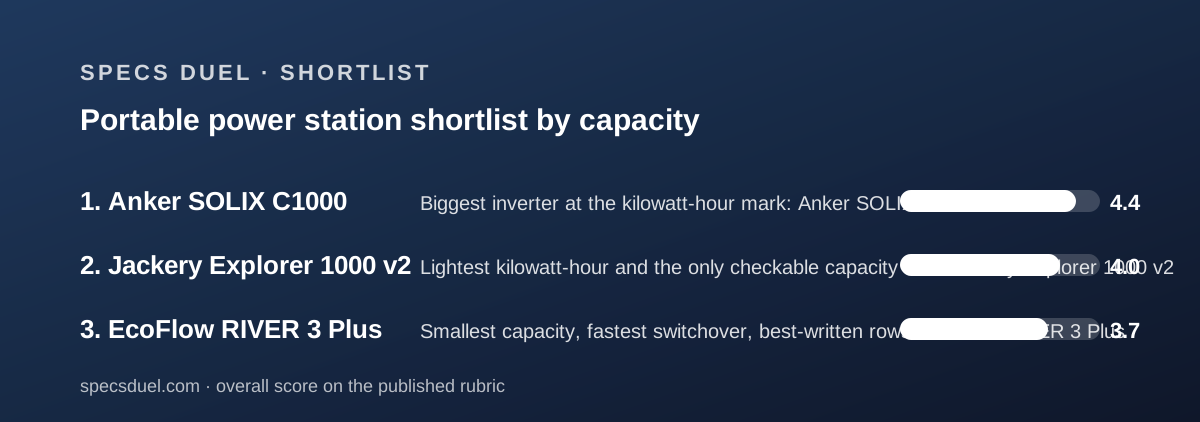
- Biggest inverter at the kilowatt-hour mark: Anker SOLIX C1000: Anker SOLIX C1000
- Lightest kilowatt-hour and the only checkable capacity row: Jackery Explorer 1000 v2: Jackery Explorer 1000 v2
- Smallest capacity, fastest switchover, best-written rows: EcoFlow RIVER 3 Plus: EcoFlow RIVER 3 Plus
The shortlist at a glance
Three sheets, two capacity classes, three jobs. The Anker SOLIX C1000 is the pick for the biggest inverter, the most outlets and the only named certification list in the group.
The Jackery Explorer 1000 v2 is the pick for the same kilowatt-hour in 4.64 lb less, and for a capacity row you can check against its own cell data.
The EcoFlow RIVER 3 Plus is the pick for the small end: under 10 ms switchover, a printed noise row, 10.4 lb and $299.00.
Capacity ladder: 286Wh, 1056Wh, 1070 Wh. Continuous output ladder: 600W, 1500W, 1800W. Those two ladders do not run in the same order, which is the first thing to notice about this category.
Price ladder: $299.00, $469.99, $519.00. Cost per watt-hour, our arithmetic: about $1.05, about 44.5 cents, about 48.5 cents. All three figures as displayed on each maker's own United States page on October 24, 2026.
Weight ladder: 10.4 lb, 23.8 lb, 28.44 lb. Capacity per pound, our arithmetic: about 27.5, about 45.0, about 37.1 watt-hours per pound. The middle unit wins that row and the heaviest one does not come second.
How we shortlisted
No electrical tests were run. Grades come from manufacturer pages rendered in a headless browser, the product markup embedded in those pages, and each maker's warranty policy table, read on October 24, 2026. Five rows set the order; three headline rows set nothing.
Published capacity decides first, and so does whether it can be checked. Jackery prints 30.4Ah at 35.2V DC behind its 1070 Wh. Anker prints 1056Wh alone. EcoFlow prints 286Wh alone.
Two of the three figures cannot be verified from the page that prints them.
Continuous AC output decides second, because it is the ceiling on what plugs in. 1800W, 1500W, 600W. Surge figures are recorded in a separate row: 2400W, 3000W peak, 1200W. Surge order is not output order.
Documentation completeness decides third. Twelve standard rows: capacity, chemistry, cycle life, AC continuous, AC surge, port list, AC charge time, solar input, UPS switchover, noise, size and weight, warranty.
Jackery fills eleven. Anker fills ten. EcoFlow fills eleven, but one of them sits on a different page.
Warranty and named certification decide fourth. Anker prints five years in its table plus four UL standards and an auditor. EcoFlow is five years, in a policy table rather than on the product page. Jackery is 3+2 years, with no standard named anywhere.
Displayed price with stock state decides fifth. All three prices could be paid on the check date, and each page's markup carried the same figure as its cart. Two of the three are dated promotions, and both pages say so.
Cycle life is not ranked. Anker prints 3,000 cycles to 80%+. EcoFlow prints 3000 cycles to 80%. Jackery prints 4000 cycles to 70%+.
A cycle count means nothing without its endpoint, and no page publishes a figure at a rival's endpoint.
Noise is not ranked either. EcoFlow prints under 30 dB with a footnote naming an 89.6F test room. Jackery claims 30 dB in copy with no method. Anker publishes no figure for this unit that we could read.
Owner scores are not ranked. Jackery publishes 4.73 from 476 reviews. Anker publishes 5.00 from 2, one of them written before delivery. EcoFlow publishes 5.0 from 1. Three incompatible samples.
Biggest inverter at the kilowatt-hour mark: Anker SOLIX C1000
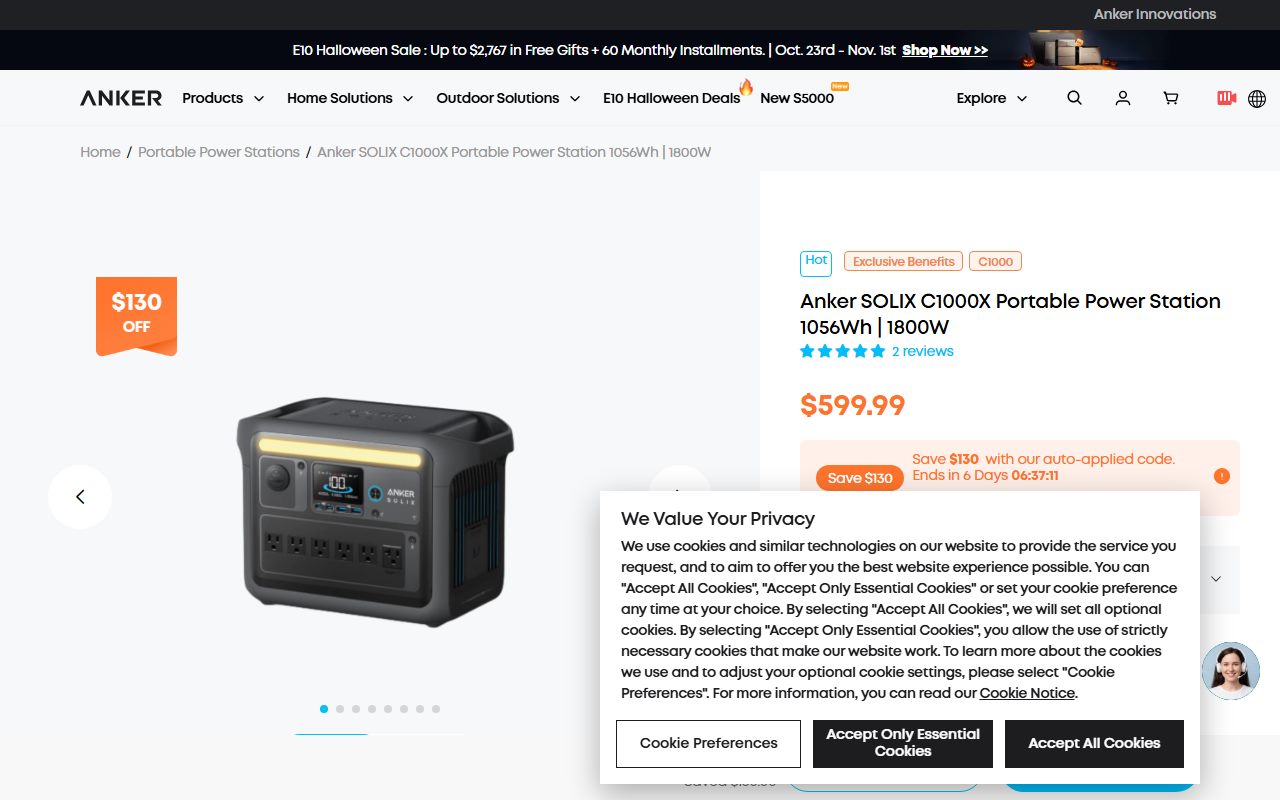
The Anker sits first because its specification table answers more of the questions a buyer asks after capacity. 1800W pure sine wave continuous. 2400W surge. Six AC outlets. 1056Wh of LiFePO4 at 3,000 cycles to 80%+.
The port block is the fullest here: six AC sockets, a car port rated 120W at 12V/10A, two 12W USB-A ports and USB-C at 100W and 30W. That is eleven outlets against seven on the Jackery sheet and six on the EcoFlow sheet.
Solar input is 600W at 11-60V with MPPT, half again what the Jackery sheet accepts and nearly three times the EcoFlow figure. Expansion to 2112Wh is printed as a specification row, not implied.
The certification answer is the row nothing else here matches. FAQ answer five names four UL standards, 1012, 1778, 1973 and 60730, and names SGS as the auditor. We weight a named standard like a warranty, because both are written commitments.
Why it sits at number one despite two blank rows: it wins all five of our ranking rows. The blanks are the noise figure, which we could not read anywhere on the page, and the charge-time row, which exists only as a 58-minute marketing bullet.
One oddity to know before ordering. The page title and embedded markup read C1000X, and the specification table, the purchase option and all seven FAQ answers read C1000. Full table in the Anker SOLIX C1000 spec sheet.
Lightest kilowatt-hour: Jackery Explorer 1000 v2
The Jackery sits second because it wins the two rows the Anker cannot touch: 23.8 lb for a full kilowatt-hour, and a capacity figure printed with its own cell arithmetic behind it.
30.4Ah at 35.2V DC multiplies to 1070.08 Wh, our calculation, which lands on the printed 1070 Wh. That is the only internal consistency check available anywhere in this shortlist.
Capacity per pound is about 45 watt-hours against about 37.1 on the Anker sheet, both our arithmetic. Over a trail or up a flight of stairs, 4.64 lb is the row that gets remembered.
It also prints three charging times where the Anker prints none: 1.58 hours on the AC adapter, 12 hours on a 12V car adapter, 7.5 hours on solar. And it prints bypass mode as a specification row at 1500W.
Then the paperwork. The headline says 0-100% in 1 Hour and the table says 1.58 Hours. The banner says five years and the row says 3+2, with the extra pair described as free, auto-activated and jackery.com only.
Why it sits at number two: it loses continuous output by 300W, outlet count by three, solar input by 200W, price by $49.01, and it prints no expansion option and no certification standard at all.
Full table in the Jackery Explorer 1000 v2 spec sheet, and row by row against the Anker in the C1000 against Explorer 1000 v2 duel.
Smallest capacity, fastest switchover: EcoFlow RIVER 3 Plus
The EcoFlow sits third on capacity, which is our first ranking row, and first on everything that depends on size, speed and how rows are written. 286Wh, 10.4 lb, 9.2 x 9.1 x 5.8 inches, $299.00.
Its switchover row is the fastest here at under 10 ms, half what either kilowatt-hour sheet publishes. For a desktop machine or a precision instrument, that is the row that decides whether anything survives a cut.
It is also the only sheet in this shortlist that prints noise as a specification row, under 30 dB, with a footnote stating the figure came from laboratory tests at a room temperature of 89.6F.
The charging rows are the best constructed in the category. AC input reads 380W and 0-100% in 60 min in the same cell. Solar reads 220W in as fast as 1.5 hours. Car input reads 220W over 3.3 hours.
Why it sits at number three: 286Wh is a quarter of what either rival publishes, 600W continuous is the smallest inverter here, there is no car or 12V output row at all, and about $1.05 per watt-hour is roughly double either kilowatt-hour sheet.
One gap worth naming: the product page prints no warranty row. The five-year term comes from the EcoFlow US warranty policy table, where the RIVER 3 one line above reads 24 months. Full table in the EcoFlow RIVER 3 Plus spec sheet.
Also compared, and why nothing else is ranked here
Specs Duel ranks only sheets it has read in full, which keeps this shortlist at three. Adding a fourth unit from a retailer listing or a search snippet would put a number in a column headed by a maker's name that the maker never printed.
That rule has cost us entries before. In the air fryer category one maker publishes no price at all, which is recorded as a missing row rather than filled from a shop.
It also means the shortlist spans two capacity classes rather than three similar units. A 286Wh unit and a 1070 Wh unit are not competitors, and the table says so rather than pretending at a close race.
The next sheets to join this cluster will be chosen the same way: a maker page that renders a full specification table in a headless browser, and a price we can read in two places on the same URL.
Pick the capacity from the load, then read the inverter
Capacity tells you how long. Continuous output tells you what. Those are different questions and the three sheets here answer them in different orders.
EcoFlow does the arithmetic for its own unit: 35 hours on a 3W Wi-Fi router, or at least 21 minutes on a 600W desktop, both from internal laboratory tests. Neither kilowatt-hour sheet offers a runtime example at all.
So for the two larger units the arithmetic is the buyer's. 1056Wh at 1800W is about 35 minutes at full load. 1070 Wh at 1500W is about 43 minutes. Both calculations are ours and both ignore conversion losses.
Then read the outlet count, because a wattage budget nobody can plug into is academic. Six sockets, three sockets, three sockets. Only one of the three pages is generous here.
Then read the expansion row. Anker to 2112Wh, EcoFlow to 858Wh, Jackery nothing. Buying the unit that cannot grow is a decision worth making knowingly.
The cycle-life row is where this category misleads hardest
Every maker here leads with a cycle count, and the counts are not measured the same way. Anker and EcoFlow measure to 80% remaining capacity. Jackery measures to 70%.
Read side by side as bare numbers, 4000 looks a third better than 3,000. Read with the endpoints attached, the two figures describe different tests and neither page publishes the other's.
Two of the three also attach a years claim to the cycle count. Anker's bullets say a 10-Year Lifespan. Jackery's say 10+ years. EcoFlow's say around 10 years of everyday use.
A cycle count becomes a lifespan only with a duty cycle, and no page states one. One full cycle a day for ten years is 3,650 cycles; one a week is 520. The gap between those two readings is the whole claim.
So we print the cycle row with its endpoint, print the years claim as copy, and rank on neither. The same rule applies to the self-measured headline figures on the Dreame L40 Ultra Gen 2 sheet.
Read the warranty page, and then look for a standard number
Three makers, three ways of publishing the same promise. Anker puts 5-Year Warranty in the specification table and adds a 30-day money-back guarantee in the trust strip above it.
Jackery puts 3+2 Years in the table and 5-Year Warranty in a banner, with the extra two years described as free, auto-activated, worth $300 and available only at jackery.com. A retailer purchase should be read as three.
EcoFlow puts nothing on the product page. Its warranty policy table lists RIVER 3 Plus at 5 years, and the RIVER 3 one row above at 24 months, so the table is model-specific rather than a blanket figure.
Then the row only one maker fills. Anker's FAQ names UL 1012, UL 1778, UL 1973 and UL 60730 and names SGS as auditor. We searched both other pages for UL and ETL strings on October 24, 2026 and found none.
That is not a claim either rival is uncertified. It is a claim about what the page selling the unit is willing to put in writing, which is the only thing a documentation site can grade.
For the same failure in another category, the Blueair Blue Pure 311i Max sheet prints three years on its product page and two on its warranty page, and the air purifier shortlist by room size ranks accordingly.
What none of the three publishes
Four rows are blank on all three sheets, and they are rows buyers ask about. Inverter efficiency. Standby drain. Per-outlet wattage limits. Any handle, strap or carry rating, on two units weighing over twenty pounds.
Standby drain is the conspicuous one. A unit bought for outages spends most of its life idle, and none of the three states how much charge it loses per week sitting switched on.
Per-outlet limits matter too. A 1800W budget across six sockets is not six 1800W sockets, and no page says how the inverter divides. A buyer planning two heavy loads has nothing to check.
Replacement-part availability is also absent everywhere. None of the three pages states whether the cells, the inverter board or the fan can be serviced, which is a strange silence beside a ten-year lifespan claim.
We will not calculate figures for any of these, because each needs a measurement none of the three makers published.
For how we handle a category where every maker prints a different self-measured headline, read the mid-range robot vacuum shortlist.
Bottom line
Buy the Anker SOLIX C1000 if the inverter and the outlet count decide it. 1800W continuous, six sockets, 600W of MPPT solar, expansion to 2112Wh, five years and four UL numbers, at $469.99 on October 24, 2026.
Buy the Jackery Explorer 1000 v2 if the unit gets carried. 1070 Wh in 23.8 lb is the best capacity-to-weight row here, and it is the only capacity figure in this shortlist you can check.
Buy the EcoFlow RIVER 3 Plus if the load is small and always on. Under 10 ms switchover, a printed noise row and 10.4 lb for $299.00, and accept 286Wh and 600W.
Row by row between the top two, read the C1000 against Explorer 1000 v2 duel. For the same difference column applied to two air purifiers, read the Coway Airmega Mighty against Blueair Blue Pure 311i Max duel.
Every number above comes from a maker's own United States product page, specification table or warranty policy, read October 24, 2026. Where a maker printed nothing, the row says so and earns nothing.
For a price that could be read and not paid, see the Roborock Q7 Max sheet.
Biggest inverter at the kilowatt-hour mark: Anker SOLIX C1000: Anker SOLIX C1000
The Anker SOLIX C1000 prints the most capability per dollar in this shortlist. Capacity is 1056Wh of LiFePO4, rated at 3,000 cycles to 80%+.
Output is 1800W pure sine wave continuous with a 2400W SurgePad surge, across six AC outlets, a 120W car port at 12V/10A, two 12W USB-A ports and USB-C at 100W and 30W.
Input is 600W of solar at 11-60V with MPPT and a 1300W AC ceiling. The rest: a UPS switch time under 20 ms, expansion to 2112Wh, 14.8 x 8.07 x 10.5 inches, 28.44 lb and a five-year warranty row.
It is the only sheet of the three that names a standard: UL 1012, UL 1778, UL 1973 and UL 60730, audited by SGS, per answer five of the page FAQ.
It sits first because it wins continuous output, outlet count, solar input, expansion, certification, warranty and cost per watt-hour, which is five of our five ranking rows outright.
The gaps are real. There is no noise figure we could read, no charge-time row in the specification table, and the page sells one unit under two names: the title and markup read C1000X, the table and FAQ read C1000.
Visit Anker SOLIX C1000
We have no affiliate relationship with this vendor. Link goes to the official site.
Lightest kilowatt-hour and the only checkable capacity row: Jackery Explorer 1000 v2: Jackery Explorer 1000 v2
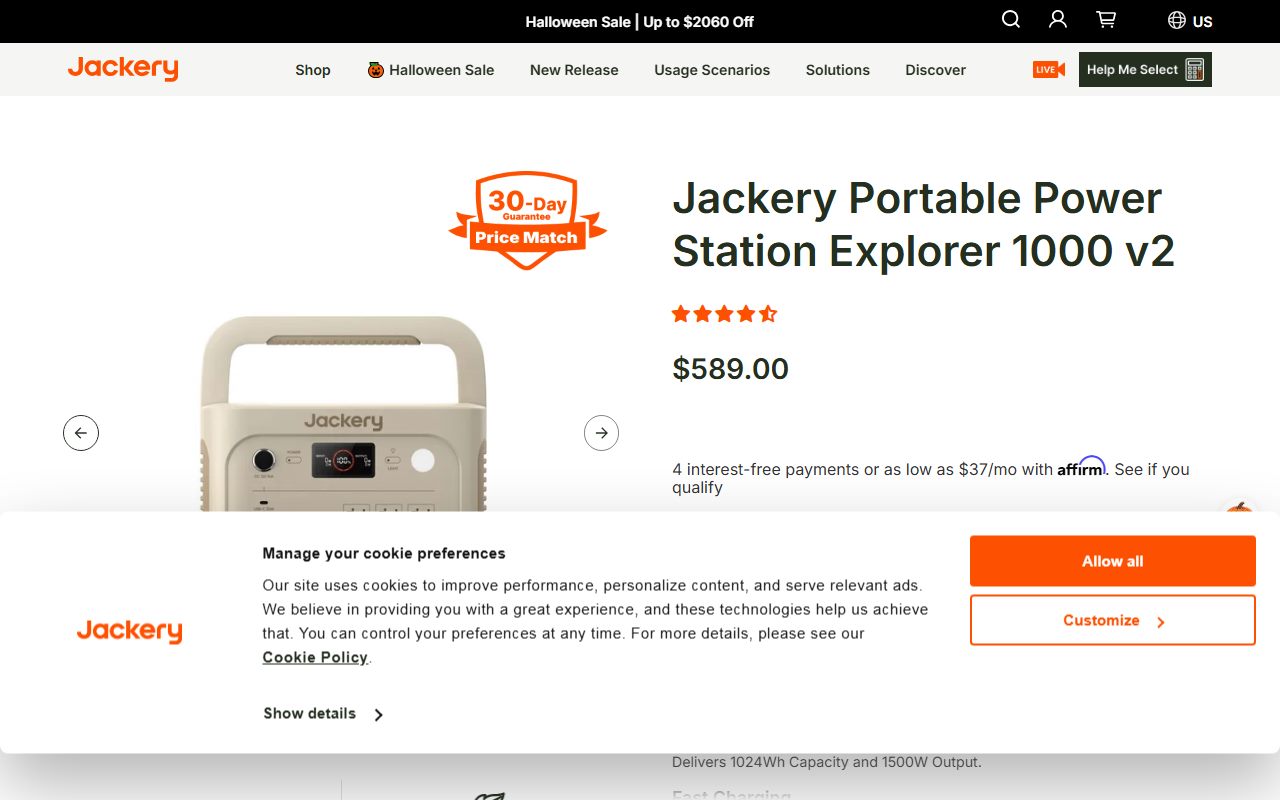
The Jackery Explorer 1000 v2 prints 30.4Ah at 35.2V DC as 1070 Wh, in LiFePO4 cells rated at 4000 cycles to 70%+ capacity.
Output is 1500W rated with a 3000W surge peak, across three 120V 60Hz outlets, USB-C at 100W and 30W, an 18W USB-A port and a 12V 10A car port.
Input is a 15A max charge mode, two DC 8mm ports doubling to 21A or 400W, and a 1500W bypass mode row. Charging times are 1.58 hours on AC, 12 hours on a car adapter and 7.5 hours on solar.
The body is 12.87 x 8.82 x 9.72 inches and around 23.8 lbs, with a warranty row of 3+2 Years.
Multiply its own cell figures and you get 1070.08 Wh, our arithmetic, which lands on the printed capacity. Neither rival page prints enough to allow that check.
It sits second because it wins weight, capacity per pound, surge peak and charge-time documentation, but loses continuous output, outlets, solar input, expansion, certification and price.
The problems are in the paperwork. The headline says 0-100% in 1 Hour while the table says 1.58 hours, the banner says five years while the row says 3+2, and no certification standard appears anywhere.
Visit Jackery Explorer 1000 v2
We have no affiliate relationship with this vendor. Link goes to the official site.
Smallest capacity, fastest switchover, best-written rows: EcoFlow RIVER 3 Plus: EcoFlow RIVER 3 Plus
The EcoFlow RIVER 3 Plus prints 286Wh of LiFePO4 at 3000 cycles to 80% capacity.
Output is 600W total across three AC outlets, with a 1200W surge and a 1200W X-Boost mode, two USB-A ports at 12W each for 24W total, and one 100W USB-C.
Input rows all carry a time: AC at 380W charging 0-100% in 60 minutes, 220W solar in as fast as 1.5 hours, 220W car input over 3.3 hours.
The rest: switchover under 10 ms, noise under 30 dB, four temperature rows, 9.2 x 9.1 x 5.8 inches and 10.4 lb.
It expands to 858Wh using the named EB300 at 286Wh or EB600 at 572Wh. The EcoFlow US warranty policy table lists this exact model at five years.
It sits third because capacity is our first ranking row and 286Wh is a quarter of what either rival publishes, and because about $1.05 per watt-hour is roughly double either kilowatt-hour sheet.
Its rows are the best written here. Every charging figure ties a time to a stated input power, and the noise row carries its test temperature.
The IP54 claim is footnoted as covering the battery pack only. The product page carries no warranty row at all.
Visit EcoFlow RIVER 3 Plus
We have no affiliate relationship with this vendor. Link goes to the official site.
How we chose
We ran no electrical tests. Grades come from manufacturer product pages rendered in a headless browser, the product markup embedded in those same pages, and the makers' own warranty policy tables, all read on October 24, 2026.
Five rows set the order.
First, published capacity, and whether the page prints enough to let that figure be checked. A watt-hour number with pack voltage and amp-hours behind it is a stronger row than the same number alone.
Second, continuous AC output, because that is the ceiling on what can be plugged in at all. Surge figures are recorded separately, since they last a fraction of a second.
Third, documentation completeness: how many of twelve standard rows the maker prints. A buyer cannot check what is not published.
Fourth, warranty as published by the maker, with any named certification standard counted in the same row. Both are written commitments rather than figures the seller measured.
Fifth, displayed price with stock state, and cost per watt-hour as our arithmetic on the two published figures.
Three rows that makers lead with are reported and not ranked. Cycle life, because the endpoints differ. Noise, because one page prints no figure and one prints a number with no method. Owner scores, because the samples are 2, 476 and 1.
Frequently asked
What capacity portable power station do I actually need?
Divide capacity by the load. EcoFlow does the arithmetic for its own unit: 286Wh runs a 3W router for 35 hours or a 600W desktop for at least 21 minutes. At the kilowatt-hour mark, 1056Wh at 1800W is about 35 minutes at full load, our calculation.
Which power station here has the biggest battery?
The Jackery Explorer 1000 v2, at 1070 Wh, 14 watt-hours above the Anker SOLIX C1000 at 1056Wh and roughly four times the EcoFlow RIVER 3 Plus at 286Wh. All three figures from the makers' own United States pages read October 24, 2026.
Which one can run the most at once?
The Anker SOLIX C1000, at 1800W continuous across six AC outlets. The Jackery publishes 1500W across three outlets and the EcoFlow 600W across three. Surge order differs: 3000W peak for the Jackery, 2400W for the Anker, 1200W for the EcoFlow.
Is a higher cycle count better?
Not as published here. Jackery prints 4000 cycles to 70%+ capacity while Anker and EcoFlow print 3,000 and 3000 cycles to 80%. Different endpoints make the counts incomparable, and no page publishes a figure at a rival's endpoint, so we rank none of them.
Which portable power station is quietest?
Only EcoFlow prints a figure as a specification row: under 30 dB, footnoted as laboratory tested at 89.6F. Jackery claims 30 dB in page copy with no method. We could read no noise figure at all for the Anker, so no ranking is possible.
Which has the longest warranty?
The Anker at five years in its specification table, matched by the EcoFlow at five years in its warranty policy table rather than on the product page. The Jackery row reads 3+2 Years, with the extra two conditional on buying at jackery.com.
Which one is cheapest per watt-hour?
The Anker SOLIX C1000, at about 44.5 cents per watt-hour, our arithmetic on $469.99 and 1056Wh. The Jackery works out to about 48.5 cents and the EcoFlow to about $1.05. All prices as displayed on October 24, 2026.
Can these be expanded with extra batteries?
Two of three. Anker prints expansion to a maximum 2112Wh and EcoFlow prints 858Wh using the named EB300 or EB600. The Jackery page carries no expansion row for this model, so 1070 Wh is its ceiling.
Do any of them name a safety certification?
Only Anker. Its FAQ names four UL standards, 1012, 1778, 1973 and 60730, audited by SGS. We searched the rendered Jackery and EcoFlow pages for UL and ETL strings on October 24, 2026 and found none on either.