 Specs

Levoit VortexIQ Pro Cordless Stick Vacuum
Seven specification rows, one of them a tolerance disclaimer, and the only suction figure in this cluster stated in air watts
Scored on the published rubric, from documentation, pricing and verified user reports.
Best for: A buyer who wants suction stated in air watts rather than pascals, who values a stated filtration standard, and who does not need a dimension row or a full-machine weight before ordering.
Verdict
The Levoit VortexIQ Pro publishes a seven-row specification block and spends one of those rows on a tolerance note. The rows read 285 W rated power, 110 AW suction, up to 60 minutes of runtime, a 3 to 4 hour charge, a 0.85 L dustbin, a 3.5 lb handheld weight, and a disclaimer that the figures may vary by plus or minus 10 W. It is the only sheet in this cluster to give suction in air watts, and the only one to name the standard behind its filtration claim, ASTM F3150, down to 0.3 microns. It publishes no dimensions, no assembled weight, no battery capacity and no noise figure. This is a documentation review built from the page rendered twice in a headless browser on November 4, 2026. Nobody here vacuumed with one.
Visit Levoit VortexIQ Pro Cordless Stick Vacuum
We have no affiliate relationship with this vendor. Link goes to the official site.
Where it is strong
- The only sheet of the three to state suction in air watts, at 110 AW, a unit that describes work done rather than sealed pressure
- Names the test standard behind the filtration claim, ASTM F3150, and the particle size it applies to, 0.3 microns
- Prints a tolerance for its own power figure, plus or minus 10 W, which neither rival sheet offers for anything
- Fastest stated charge of the three at 3 to 4 hours, against 4 hours and 6 hours
- Package contents list runs to twelve items including a charging dock, wall anchors and a mini motorised brush
- The product page badge states a two year warranty, double the term the cheapest rival badges
Where it falls short
- No dimension row of any kind on the page read November 4, 2026, so the machine cannot be measured against a cupboard
- The weight row is labelled handheld weight, so the assembled figure a buyer actually lifts is never published
- No battery capacity, no cell count and no noise figure on the page read November 4, 2026
- The runtime row says up to 60 minutes and never states the mode or the attachment it was measured with
- The anti-tangle claim is footnoted to an independent lab that is not named, so the test cannot be looked up
- The headline comparison is 30 percent more powerful than the previous VortexIQ, and that older figure is not printed for the reader to check
At a glance
| Rated power | 285 W |
|---|---|
| Suction | 110 AW |
| Power tolerance stated by the vendor | May vary plus or minus 10 W |
| Runtime | Up to 60 mins |
| Charging time | 3 to 4 hours |
| Dustbin capacity | 0.85 L |
| Handheld weight | 3.5 lb |
| Filtration | 5-stage HEPA, 99.99 percent of fine particles, tested per ASTM F3150 down to 0.3 microns |
| Dust detection | NeoSight high-contrast LED with 150 degree coverage |
| Brush | Anti-tangle roller brush, third generation TripleStrike |
| Reach | 180 degree lay-flat design |
| Bin claim | Up to 3,000 sq ft of floor between emptyings |
| Display | LED display |
| Package contents | Vacuum body, battery, long stick, short stick, vacuum head, 2-in-1 crevice tool, mini motorised brush, charging dock, three screws, three wall anchors, charger, manual |
| Warranty | Two year warranty badge on the product page |
| Returns | 30 day money back guarantee badge on the product page |
| SKU | HEAPVCLVNUS0043Y |
| Dimensions | No figure on the page read November 4, 2026 |
| Assembled weight | No figure on the page read November 4, 2026 |
| Battery capacity | No mAh or cell figure on the page read November 4, 2026 |
| Noise level | No figure on the page read November 4, 2026 |
| Price | $249.99, compare-at $299.99 (read November 4, 2026) |
| Pricing note | $249.99 with a compare-at price of $299.99 in the page's own product data, read November 4, 2026 |
What the VortexIQ Pro actually is
This is a cordless stick vacuum with a detachable battery pack and a floor head that lies flat. Levoit gives the lay-flat angle as 180 degrees.
The battery is removable in a way the page makes a point of. It can be charged on the machine, in the dock, or taken out and plugged into the charger on a counter.
The floor head carries an anti-tangle roller brush. Levoit calls the mechanism TripleStrike and says this is its third generation.
A lamp named NeoSight throws a high-contrast LED beam across the floor. The page gives its spread as 150 degrees, which is a real number on a feature that is usually described with adjectives.
The machine is described as self-standing on hard floors. There is no wall mount in the box, but three screws and three wall anchors are listed, which implies a wall fixing is expected.
Who this sheet is for
This sheet suits a buyer whose comparison runs on units rather than on photographs:
- Someone who shops in air watts, because this is the only sheet of the three that uses them
- Someone who wants a filtration standard named, which ASTM F3150 and 0.3 microns do here
- Someone who charges overnight and wants the shortest stated wait, at 3 to 4 hours
- Someone who counts what arrives in the box, since twelve items are itemised
- Someone willing to trade a dimension row for a lower price than the dearest rival in this cluster
- A reader who reads appliance sheets the way our air purifier shortlist reads them, row by row
- Someone who treats a missing row as a reason to keep looking, as our Blueair Blue Pure 311i Max sheet does
Seven rows, and one of them is a disclaimer
The block headed Product Specifications contains seven lines. Six carry figures and the seventh carries a tolerance.
Rated power 285 W. Suction 110 AW. Runtime up to 60 mins. Charging time 3 to 4 hours. Dustbin capacity 0.85 L. Handheld weight 3.5 lb.
The seventh line reads: disclaimer, may vary plus or minus 10 W. Levoit has attached an asterisk to the power row and to the suction row and pointed both at that note.
Spending a seventh of a short specification block on a tolerance is unusual, and it reads as honesty rather than padding. Neither rival sheet in this cluster offers a tolerance for anything.
It is also slightly loose. A tolerance expressed in watts cannot be applied to an air watt figure without a conversion the page does not supply.
Seven rows is still the shortest useful sheet of the three. For a sheet in another category that spends its rows on the object rather than on the claims, see the Coway Airmega AP-1512HH sheet.
Air watts against pascals is not a conversion a buyer can do
This is the only sheet in the cluster that gives suction in air watts. The cheapest rival gives pascals. The dearest gives neither.
Air watts describe airflow against resistance, which is closer to work done on a carpet. Pascals describe sealed pressure with the inlet blocked.
The two cannot be converted into each other without knowing the airflow curve of each machine, and no sheet in this cluster publishes a curve.
So a reader looking at 110 AW on this page and 26,000 Pa on a rival page is looking at two unrelated measurements, not a high figure and a higher one.
This review prints both and ranks neither against the other. Treating incompatible units as a league table is the most common error in this category.
The same refusal shows up in our robot vacuum shortlist, where pascal ratings differ by test rig between brands.
Sixty minutes with no mode attached
The runtime row reads up to 60 mins. All three sheets in this cluster print sixty, which makes the footnotes the only thing worth reading.
This page supplies no footnote. There is no mode named, no attachment named and no test report referenced for the runtime figure.
That is a real gap, because the two rival sheets both narrow their sixty. One states ECO mode with a non-motorized tool. The other states Eco Mode with a crevice nozzle.
Both of those footnotes describe a low-draw configuration. The absence of a footnote here does not mean a better figure; it means the figure cannot be placed.
Against the 3 to 4 hour charge, sixty minutes of runtime is a three to one or four to one ratio of charging to cleaning by our arithmetic, the best of the three.
The page also offers no second runtime figure for a boost mode, so there is one point and no curve.
The weight row measures the part that is lightest
The only weight on this sheet is 3.5 lb, and the row is labelled handheld weight.
That is the figure for the motor unit, the bin and the battery, held like a jug. It is not the figure for the machine with a stick and a floor head attached.
The gap between those two numbers is not small. On the one sheet in this cluster that publishes both, the assembled figure is 7.1 lbs and the handheld figure is 3.5 lbs.
So a buyer reading 3.5 lb here and 7.1 lbs on a rival sheet may conclude this machine is half the weight. The two rows are not measuring the same object.
This is the clearest example in the cluster of why a label matters more than a number. The row is accurate and the comparison it invites is not.
We treat mismatched measurement bases the same way in our air fryer shortlist, where quart ratings are brand-specific.
The filtration row is the best-documented claim on the page
Levoit claims a five stage system with HEPA, capturing 99.99 percent of fine particles including dust, pet dander and pollen.
The footnote is the part that counts: tested per ASTM F3150, down to 0.3 microns. A standard and a particle size are both named.
That is more than either rival sheet offers. One prints only the word HEPA with no efficiency figure. The other prints 99.9 percent and a particle size but no test standard.
The difference between 99.9 and 99.99 percent looks trivial written down. It is a tenfold difference in what passes through, by our arithmetic.
Whether a buyer can feel that difference is a separate question this sheet does not answer, and neither does this review.
For another product where the maker published the standard rather than only the result, see the Levoit Core 300S sheet.
Four rows the page does not print
There is no dimension row. No length, no width, no height, in inches or in millimetres, on either render of this page on November 4, 2026.
There is no assembled weight, as described above. There is no battery capacity, in mAh or in watt hours, and no cell count.
There is no noise figure in decibels. One rival sheet omits it too; none of the three publishes one, which appears to be a category habit rather than a Levoit choice.
This review does not say Levoit withholds these rows. It says they were not on the page on that date, after two headless renders searched for exact strings.
The absence of a dimension row is the one a buyer will notice. A stick vacuum has to live somewhere, and this page offers no way to check whether it fits.
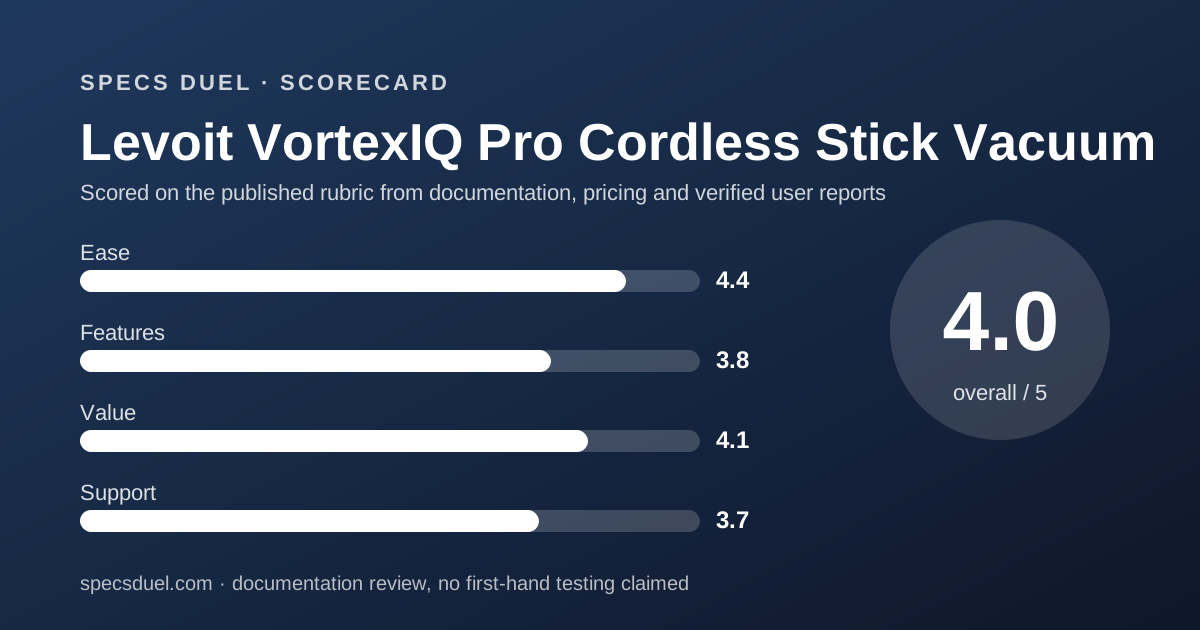
Ease of use: what the 4.4 is built from
This is the highest ease score in the cluster, and most of it comes from the battery arrangement.
The pack detaches and charges three ways: on the machine, in the dock, or plugged in on its own. That removes the usual constraint of parking the whole machine beside an outlet.
The 180 degree lay-flat design is the second contributor. A head that goes fully flat reaches under a bed without the user kneeling.
The page says the machine is self-standing on hard floors, which means the dock is optional rather than structural.
The points held back are for what cannot be read. Without a dimension row, a buyer cannot tell whether the machine stands where it is wanted, and without an assembled weight, cannot tell how it carries upstairs.
Features: what the 3.8 is built from
This is the lowest feature score in the cluster, and it is a judgement about rows rather than about hardware.
The named technologies are real and specific: NeoSight at 150 degrees, TripleStrike in its third generation, a five stage filter with a standard attached, an LED display.
What is missing is a second figure for any of them. There is no suction figure for a second mode, no runtime for a second mode, and no bin figure other than 0.85 L.
The twelve item package list is the strongest part of this column, and it includes a charging dock, which the dearest rival in this cluster does not ship.
Against that, the headline claim of 30 percent more power than the previous VortexIQ is unverifiable from this page, because the older figure is not printed here.
Value: what the 4.1 is built from
At $249.99 this sits in the middle of the cluster, between $199.99 and $429.99.
Against the 0.85 L bin, $249.99 works out at about $294 per litre of rated bin volume by our arithmetic. The cheapest rival is near $200 and the dearest near $909.
The compare-at price of $299.99 in the page's own product data means the listed figure was presented as a $50 reduction that day. A buyer should expect that framing to move.
What the price buys that the cheapest rival does not offer is a named filtration standard, an air watt figure, a charging dock and a two year badge rather than a one year badge.
What it does not buy is a dimension row or an assembled weight, both of which the dearest rival prints.
The same shape of trade shows up in our portable power station shortlist, where the middle option often documents best.
Support: what the 3.7 is built from
The product page badges a two year warranty and a 30 day money back guarantee. Both are badges in the trust strip, not rows in the specification block.
That placement matters on a site that compares sheets. A badge is a marketing element that can change without a changelog; a specification row is a commitment.
Two years is still double the term the cheapest rival badges, and the money back window is stated in days rather than left to a policy page.
What is absent is everything behind the term. No parts availability statement, no stated repair route, no response time, and no separate term for the battery.
A battery term is the gap that stings most here. On a machine whose main consumable is a lithium pack, the sheet says nothing about how long that pack is covered.
The Roborock Q7 Max sheet has the same hole in the same place.
How this sheet was read
The product page was rendered twice in a headless browser on November 4, 2026, and each rendered document was searched for exact strings rather than summarised.
Both renders returned the same seven specification lines, the same twelve package items, the same footnotes and the same price. Nothing disagreed between them.
Where the two renders had disagreed, the figure would have been dropped and this review would have said so, rather than averaging them or choosing one.
The price was confirmed twice inside the same document, once in the Shopify product data in cents and once in the analytics payload in dollars, along with the compare-at figure and the SKU.
No number here comes from a retailer listing, a search result snippet or a summary tool. Levoit sells direct, so no retailer was needed.
We did not vacuum with this machine, and this page does not claim otherwise. The same rule governs our eufy X10 Pro Omni sheet.
Bottom line
This is the best-documented claim sheet in the cluster and the worst-documented object. The things it measures, it measures carefully; the machine itself it barely describes.
Buy it if air watts, a named filtration standard and the fastest stated charge are what settle the purchase, and if the machine's size is not a constraint.
Skip it if you need to measure a cupboard, if the assembled weight is the row you compare on, or if a runtime figure with no mode attached is not worth having.
For another maker that published a lab reference instead of a bare figure, see the Dreame L40 Ultra Gen 2 sheet.
For a category where two makers measured the same thing on different bases, see the Ninja AF181 against Philips NA340 duel and the EcoFlow RIVER 3 Plus sheet.
Buy it if
- Air watts is the unit you shop in, because this is the only sheet of the three that publishes one and the cheapest rival publishes pascals instead
- A named filtration standard matters, since ASTM F3150 and 0.3 microns are both printed rather than implied by the word HEPA
- Charge time is the constraint, as 3 to 4 hours is the fastest stated figure in this cluster
- You want the accessories in the box, which here means twelve listed items including a dock and the wall fixings
Skip it if
- You need to measure before buying, because there is no length, width or height anywhere on this page
- The assembled weight is the deciding row, which this sheet replaces with a handheld figure of 3.5 lb
- You want a runtime you can reproduce, since the sixty minute row carries no mode and no attachment
- Battery capacity is part of your comparison, as no cell count and no mAh figure are published here
Frequently asked
How much does the Levoit VortexIQ Pro cost?
$249.99, read November 4, 2026. The page's own product data carries a compare-at price of $299.99 alongside it, so the listing presented the lower figure as a reduction from $299.99 that day.
How much suction does the Levoit VortexIQ Pro have?
110 AW, per the specification block read November 4, 2026. The asterisk on that row points to a disclaimer that figures may vary by plus or minus 10 W, which is a watt tolerance rather than an air watt one.
How long does the VortexIQ Pro run for?
Up to 60 minutes, per the runtime row. The page does not state which mode or which attachment produced that figure, which is the one disclosure the two rival sheets in this cluster both provide.
How big is the dustbin?
0.85 L. The page adds that this is enough to cover up to 3,000 sq ft of floor between emptyings. That second figure is a claim about coverage, not a measurement of the bin.
How heavy is the Levoit VortexIQ Pro?
The only weight published is 3.5 lb, and the row is labelled handheld weight. No figure for the assembled machine with the stick and floor head appeared on the page read November 4, 2026.
Does the VortexIQ Pro have a HEPA filter?
Yes, inside a five stage system. The page claims 99.99 percent of fine particles and footnotes the claim to ASTM F3150, down to 0.3 microns, which is more detail than either rival sheet gives.
What is the Levoit VortexIQ Pro warranty?
The product page carries a two year warranty badge next to a 30 day money back guarantee. Neither appears as a row inside the specification block, so the term sits in the trust strip rather than the table.
Is the VortexIQ Pro more powerful than the standard VortexIQ?
The page claims 30 percent more power than the Levoit VortexIQ. It does not print the older model's figure on this page, so the comparison cannot be checked from this sheet alone.
Sources
Update history
- November 4, 2026 - First publication. Product page rendered twice in a headless browser on November 4, 2026 and searched for exact strings; both renders returned the same seven specification lines and the same price and compare-at price.
Visit Levoit VortexIQ Pro Cordless Stick Vacuum
We have no affiliate relationship with this vendor. Link goes to the official site.